
There was a time when almost any room with white shiplap, a distressed console, a black metal light fixture, and a sign saying “Gather” could be called farmhouse style.
That version has aged.
The modern farmhouse homes that feel convincing now are quieter, warmer, and much more personal. They borrow the usefulness and honesty of traditional farm buildings—wood, stone, sturdy furniture, practical storage, generous tables, simple forms—without trying to turn an ordinary house into a themed country set.
The modern part matters just as much as the farmhouse part.
Clean cabinetry, large windows, restrained decoration, contemporary lighting, uncluttered layouts, and comfortable furniture keep the style from becoming overly rustic. Older pieces, visible grain, handmade ceramics, natural textiles, and materials that improve with age prevent the same room from feeling sterile.
Architectural Digest describes farmhouse style as rooted in homes that historically relied on readily available materials such as wood and stone and were designed around comfort and utility. Its modern variation introduces cleaner lines, lighter decoration, neutral palettes, and contemporary finishes.
That history explains why the best farmhouse-inspired homes don’t depend on decorative clichés.
They depend on practicality.
This guide covers the full picture: architecture, color, wood, kitchens, living rooms, bedrooms, bathrooms, furniture, lighting, flooring, exterior details, common mistakes, budgets, and ways to make the look feel current rather than copied.
What Is Modern Farmhouse Style?
Modern farmhouse is an interior and architectural style that combines practical features associated with traditional rural homes with cleaner contemporary forms.
Its typical ingredients include:
- natural wood
- stone
- simple furniture
- comfortable upholstery
- neutral or earthy colors
- functional storage
- straightforward architectural details
- large or visually open living spaces
- black, bronze, brass, or iron accents
- vintage pieces mixed with newer furniture
- restrained rustic texture
Traditional farmhouse design tends to feel older, more collected, and sometimes more decorative.
Contemporary design tends to emphasize simplified forms and reduced visual clutter.
Modern farmhouse sits between the two.
Architectural Digest notes that modern farmhouse interiors tend to use cleaner lines and contemporary finishes while traditional farmhouse rooms may rely more heavily on vintage furniture, familiar patterns, aged materials, and deeper colors.
The balance is what makes the style work.
Too rustic, and the room starts looking themed.
Too modern, and the warmth disappears.
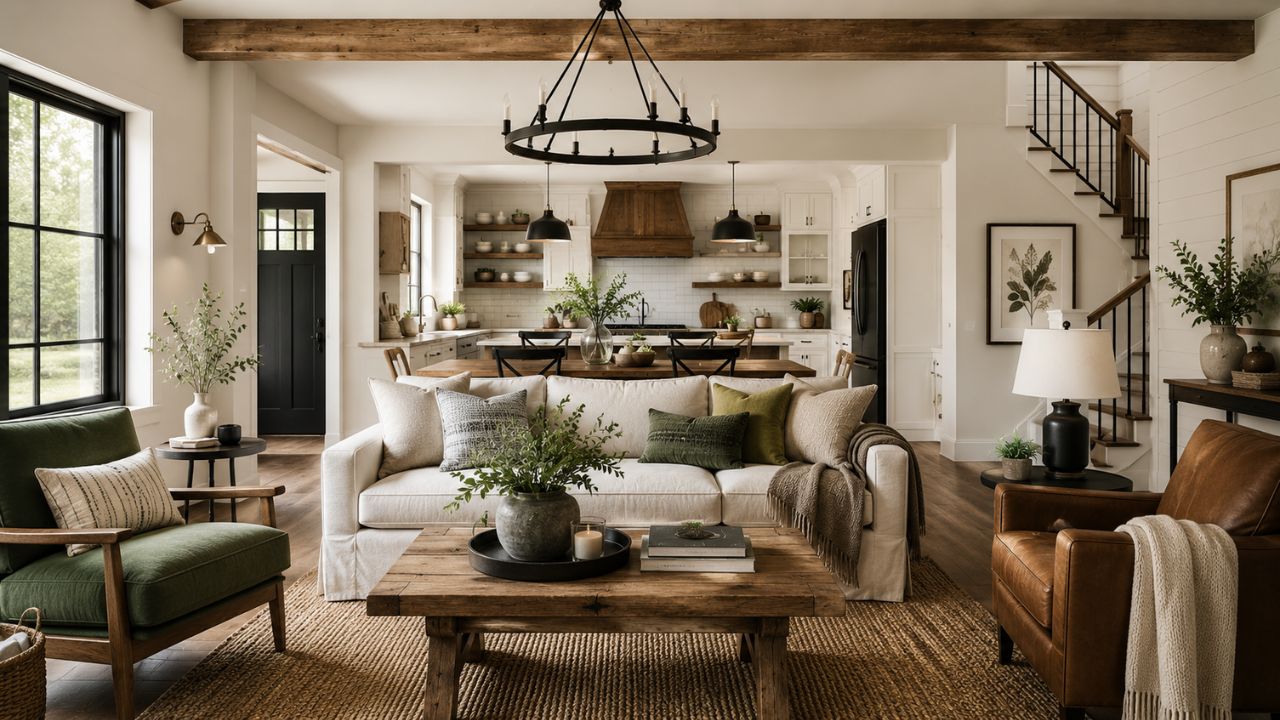
Featured Snippet: What Defines Modern Farmhouse Interior Design?
Modern farmhouse interior design combines simple contemporary lines with warm natural materials, practical furniture, wood, stone, neutral or earthy colors, vintage accents, comfortable textiles, and restrained rustic details. The goal is a home that feels useful, relaxed, collected, and current rather than heavily themed.
Where Did Modern Farmhouse Style Come From?
Farmhouse design began with function, not decoration.
Historic rural homes were built to support everyday working life. Materials often came from what was locally obtainable, and interiors had to cope with dirt, weather, food preparation, storage, family activity, and agricultural work.
That practical foundation still matters.
The National Park Service documents American farmsteads as examples of vernacular architecture—buildings shaped strongly by local needs, materials, climate, and working conditions rather than a single formal decorative rulebook.
The modern interpretation became especially visible in American popular culture during the 2010s. Architectural Digest credits Joanna Gaines and Fixer Upper, which premiered in 2013, as a major influence in bringing the style to a mass audience.
That popularity eventually created its own problem.
Once shiplap walls, barn doors, galvanized metal, distressed furniture, gray flooring, black windows, and decorative signs appeared everywhere, farmhouse style became easier to imitate than to understand.
The more interesting direction now is a return to the original idea:
simple materials + comfortable living + usefulness + craftsmanship.
Is Modern Farmhouse Still in Style in 2026?
Yes, but the strongest examples look different from the heavily branded farmhouse interiors of the late 2010s.
Current design reporting increasingly favors warmer, more personal rooms and discourages elements that feel mass-produced or overly staged. Recent designer commentary specifically calls out farmhouse word signs, overly gray rooms, matching furniture sets, and reliance on one overhead light as choices that can make interiors feel dated.
At the same time, designers continue to use farmhouse principles successfully through:
- natural stone
- warm woods
- aged finishes
- vintage furniture
- handmade objects
- clean cabinetry
- traditional architectural references
- layered fabrics
- mixed metals
- personal artwork
Architectural Digest has also highlighted designers creating refined farmhouse interiors with antiques, richer materials, unexpected colors, and carefully selected contemporary elements.
So the style is not disappearing.
It is maturing.
Modern Farmhouse vs Traditional Farmhouse
Understanding the difference prevents expensive design mistakes.
| Feature | Modern farmhouse | Traditional farmhouse |
|---|---|---|
| Color palette | Warm neutrals, earth tones, restrained contrast | Cream, deeper reds, greens, blues, aged neutrals |
| Furniture | Mix of clean-lined and vintage pieces | More antique, rustic, handcrafted pieces |
| Lighting | Simple contemporary, industrial, aged metal | Traditional lanterns, shaded lamps, classic fixtures |
| Wood | Natural but controlled | More visibly aged and rustic |
| Walls | Plaster, subtle paneling, paint | Plank walls, beadboard, traditional trim |
| Kitchen | Clean cabinetry and hidden function | Freestanding furniture and traditional detailing |
| Decor | Sparse and personal | More collected and layered |
| Overall feeling | Fresh, warm, edited | Historic, cozy, rustic |
Neither is better.
The question is how far you want to move toward contemporary simplicity or traditional character.
Modern Farmhouse vs Rustic Style
Rustic design often highlights roughness.
Think:
- heavily weathered timber
- chunky beams
- rough stone
- distressed leather
- aged metals
- visible imperfections
Farmhouse interiors can contain those materials, but they usually feel lighter and more domestic.
A modern farmhouse living room may have one rough reclaimed beam but pair it with clean sofas and smooth plaster walls.
A fully rustic room may use rough wood across the ceiling, fireplace, tables, doors, and cabinetry.
The distinction is one of intensity.
Modern Farmhouse vs Scandinavian Farmhouse
These styles overlap because both value simplicity, natural material, and practical furniture.
Scandinavian farmhouse tends to be:
- lighter
- quieter
- paler
- more minimalist
- strongly influenced by Nordic furniture forms
Modern American farmhouse can tolerate more contrast, heavier furniture, darker metal, deeper woods, and traditional architectural details.
Scandinavian farmhouse often uses white, light brown, unfinished wood, plants, clay, and restrained blackaccents.
If you want farmhouse warmth without heavy rusticity, Scandinavian influence is a useful direction.
The Modern Farmhouse Color Palette
One of the biggest changes in this style is color.
The old formula depended heavily on:
bright white + cool gray + matte black.
That combination can still work, but using it everywhere tends to flatten a room.
A stronger palette uses warmer neutrals and earthy colors.
Best Base Colors
Consider:
- creamy white
- ivory
- warm beige
- oatmeal
- mushroom
- taupe
- putty
- soft greige
- warm stone
These colors allow wood grain and natural fabrics to feel richer.
Best Accent Colors
Farmhouse interiors work especially well with:
- olive green
- sage
- forest green
- muted navy
- dusty blue
- burgundy
- rust
- terracotta
- clay
- tobacco brown
- charcoal
Traditional farmhouse interiors historically accommodate deeper green, blue, and burgundy tones, which can also bring welcome depth to a cleaner modern room.
Should a Modern Farmhouse Be White?
No.
White is useful, not compulsory.
A white room works best when it contains enough material variation:
- warm oak
- natural linen
- aged brass
- stone
- woven baskets
- wool
- handmade ceramics
- darker furniture
Without texture, an all-white room can feel empty.
Farmhouse style gets its warmth from material variation more than decorative clutter.
A mushroom-colored kitchen, muted green pantry, plaster-toned living room, or warm beige bedroom can still read clearly as modern farmhouse.
The Best Wood Colors for Modern Farmhouse Interiors
Wood is arguably more important than wall paint.
Good options include:
White Oak
Light, calm, and easy to combine with warm white, green, beige, black, and stone.
Use it for:
- flooring
- dining tables
- cabinetry
- vanities
- bedroom furniture
Reclaimed Wood
Useful when you want age and texture.
Use it selectively.
One reclaimed table can add character.
Five heavily distressed wood surfaces can make the room feel artificial.
Walnut
Walnut adds depth and prevents pale farmhouse interiors from feeling washed out.
It works beautifully in:
- dining tables
- dressers
- occasional tables
- kitchen islands
- bedside furniture
Pine
Pine can suit more casual farmhouse interiors, especially when naturally finished rather than aggressively distressed.
Medium Brown Wood
Medium warm brown creates an easy bridge between traditional and contemporary pieces.
The goal isn’t to choose one species for the entire house.
Mixed woods often feel more authentic.
How to Mix Wood Tones in a Modern Farmhouse
A collected farmhouse should not look as if every wooden object arrived in the same delivery truck.
Start with one dominant wood.
That could be your flooring.
Then add a second finish with a clear relationship.
For example:
Dominant: light oak floor
Secondary: medium walnut table
Accent: aged oak stool
Or:
Dominant: walnut cabinetry
Secondary: natural oak flooring
Accent: painted furniture
A rug is extremely useful between wood furniture and wood flooring because it prevents competing grains from touching directly.
Repeated undertones matter more than exact matching.
Natural Materials Are the Foundation
A convincing farmhouse room usually contains materials that look and feel real.
Prioritize:
- wood
- natural stone
- linen
- cotton
- wool
- leather
- clay
- ceramic
- woven fibers
- metal
- plaster
These materials age differently, which helps a room gain personality over time.
Architectural Digest repeatedly identifies natural materials—particularly wood and stone—as central to both traditional and contemporary farmhouse design.
You do not need every material on the list.
Three or four used consistently can establish the style.
Modern Farmhouse Flooring
Flooring creates one of the largest uninterrupted surfaces in a home.
Wide-Plank Wood
Wide boards strongly support farmhouse character.
For a cleaner appearance, avoid extremely artificial distressing.
Natural oak, medium brown, and lightly aged finishes are easier to live with long term.
Stone
Natural stone works beautifully in:
- entries
- kitchens
- mudrooms
- bathrooms
Limestone-inspired finishes are especially compatible with warm farmhouse palettes.
Brick
Brick floors can work in entries, utility spaces, and sunrooms where you want a stronger traditional reference.
Tile
Choose tile that feels connected to natural material:
- terracotta
- stone-look porcelain
- simple neutral ceramic
Avoid making every floor a decorative statement.
Walls: Go Beyond Shiplap
Shiplap became so strongly associated with farmhouse style that many homeowners assume it is mandatory.
It isn’t.
In fact, covering every wall in horizontal boards can make a home feel more themed.
Better options include:
- painted drywall
- limewash-inspired finishes
- plaster texture
- tongue-and-groove used selectively
- beadboard
- vertical paneling
- simple wall molding
- brick
- stone
If you love shiplap, choose one area where the architecture justifies it.
A mudroom or vaulted ceiling may make more sense than all four walls of every room.
Modern Farmhouse Living Room Ideas
The living room should feel comfortable before it feels styled.
Start with seating.
Choose sofas and chairs that invite actual use. Slipcovered upholstery, linen blends, cotton, soft leather, textured wool, and durable woven fabrics all work.
Avoid filling the room exclusively with bulky furniture.
Balance a deep sofa with:
- lighter accent chairs
- an open-leg coffee table
- simple side tables
- a substantial rug
A Reliable Living Room Formula
Walls: warm ivory
Floor: natural oak
Sofa: oatmeal linen-look upholstery
Chairs: brown leather or muted green fabric
Coffee table: aged medium wood
Lighting: blackened bronze floor lamp
Curtains: natural linen
Accent: vintage art
Notice what is missing:
- word signs
- fake windmills
- decorative milk cans
- mass-produced farm graphics
You don’t need symbols of farming to create farmhouse character.
The Fireplace in a Modern Farmhouse
Fireplaces naturally suit farmhouse interiors because they provide visual and literal warmth.
Good materials include:
- natural stone
- limewashed brick
- aged brick
- simple plaster
- wood mantels
Avoid overdecorating the mantel.
A few strong objects are usually enough:
- artwork
- ceramic vase
- pair of candlesticks
- branch clipping
A mantel covered from end to end in small decorative objects can make an otherwise calm room feel busy.
Modern Farmhouse Kitchen Design
The kitchen is where farmhouse logic makes the most sense.
Traditional farmhouses required hardworking kitchens. Modern kitchens still benefit from the same focus on durability, preparation space, storage, and easy movement.
Cabinet Colors
Strong choices include:
- warm white
- cream
- mushroom
- natural oak
- medium walnut
- muted green
- charcoal
- deep blue
Two-tone cabinetry can work when the division is logical.
For example:
perimeter: warm white
island: natural oak
or:
perimeter: light oak
island: muted green
Shaker Cabinets: Farmhouse Classic
Shaker-style cabinetry fits farmhouse interiors because the door construction is simple and familiar.
Avoid excessive ornament.
The cabinetry should provide structure rather than become the loudest object in the kitchen.
Flat-panel cabinetry can also work in a more contemporary farmhouse, particularly when paired with natural stone and traditional hardware.
The Farmhouse Sink
Apron-front sinks remain strongly associated with farmhouse kitchens.
They can be attractive and practical, but don’t choose one simply because the style demands it.
Consider:
- sink depth
- countertop installation
- cabinet requirements
- maintenance
- material
- working habits
A standard undermount sink can still belong perfectly well in a farmhouse-inspired kitchen.
Style should not override usability.
Kitchen Countertops
Farmhouse countertops work best when they appear durable rather than flashy.
Common directions include:
- marble
- marble-look quartz
- soapstone
- quartzite
- warm neutral quartz
- wood in limited areas
Highly dramatic veining can push the room toward luxury contemporary design.
That is not necessarily wrong, but it changes the balance.
For a restrained room, choose stone with quieter movement.
Kitchen Lighting
One oversized black pendant above an island does not automatically create farmhouse style.
Lighting should be layered.
A practical kitchen may combine:
- natural daylight
- ceiling lighting
- island pendants
- under-cabinet task lighting
- small decorative lamps
- wall sconces
Recent kitchen design advice continues to stress the value of combining ambient, task, accent, and natural lighting instead of depending on one source.
That principle is especially useful in farmhouse interiors, where warmth matters.
Open Shelving: Use It Carefully
Farmhouse kitchens helped popularize open shelves.
They look wonderful when they hold:
- everyday ceramics
- glasses
- bowls
- cutting boards
- cookware
They look less convincing when every shelf exists only for decorative filler.
If you use open shelving, allow function to guide the styling.
Recent designer guidance also suggests maintaining cohesion in color, material, and scale to keep open kitchen shelving from becoming visually cluttered.
Modern Farmhouse Dining Room
The dining room is one of the easiest spaces to style.
Start with a substantial table.
It does not need to look 150 years old.
A clean oak or walnut table can work better than a heavily distressed reproduction.
Pair it with:
- woven chairs
- upholstered end chairs
- simple wooden chairs
- bench seating used selectively
Then introduce one strong light fixture.
The room should feel grounded around the table.
Farmhouse dining spaces are at their best when they look ready for people rather than photography.
Should Dining Chairs Match?
Not always.
Identical chairs create order.
Mixed chairs create history.
A safe middle ground is to use one chair style along the sides and different host chairs at the ends.
Another approach is to keep the shape consistent but vary the finish.
This creates a collected look without visual chaos.
Modern Farmhouse Bedroom Ideas
Bedrooms benefit from the softer side of farmhouse design.
Avoid making the room overly rustic.
A comfortable upholstered or wooden bed should dominate the composition.
Add:
- warm neutral bedding
- layered blankets
- wooden nightstands
- ceramic lamps
- simple artwork
- linen curtains
- wool or woven rug
Easy Bedroom Palette
Walls: soft putty
Bed: natural oak
Bedding: ivory + oatmeal
Nightstands: medium walnut
Accent: muted olive
Lighting: aged brass
This room feels farmhouse-inspired without using a single cliché.
Bedding and Textiles
Texture carries more weight than pattern.
Useful materials include:
- linen
- washed cotton
- wool
- quilting
- subtle checks
- narrow stripes
Avoid making every textile rustic.
One small plaid cushion may work.
Plaid bedding, plaid curtains, checked rug, and buffalo-check bench upholstery will push the room into theme territory quickly.
Modern Farmhouse Bathroom
A farmhouse bathroom should be practical and easy to clean.
Good combinations include:
Option 1: Light and Warm
- oak vanity
- cream walls
- white stone countertop
- brass fixtures
- simple rectangular mirror
Option 2: Dark and Traditional
- walnut vanity
- warm white walls
- aged bronze fixtures
- stone flooring
- framed mirror
Option 3: Soft Country Modern
- muted green vanity
- ivory tile
- oak accessories
- brass sconces
You do not need a vessel sink, barn door, or distressed vanity to establish the style.
Modern Farmhouse Entryway
Farmhouse homes historically valued practical transitions between outdoors and indoors.
A modern entry should do the same.
Think about actual needs:
- shoes
- bags
- coats
- keys
- umbrellas
- pet supplies
Use:
- bench
- hooks
- concealed cabinets
- durable floor
- washable rug
- basket storage
Function is more authentic to farmhouse design than decorative farm objects.
Mudrooms: Where Farmhouse Design Makes Perfect Sense
Few spaces fit the farmhouse idea better than a mudroom.
A useful layout might combine:
- bench seating
- closed shoe storage
- coat hooks
- overhead cabinets
- durable tile
- utility sink
- washable runner
Choose finishes that improve with wear.
Perfect high-gloss surfaces are often less suitable here than wood, stone, tile, and aged metal.
Modern Farmhouse Office
A home office can use darker tones than other rooms.
Try:
- walnut desk
- olive cabinetry
- cream wall
- leather desk chair
- vintage art
- linen shade
- aged brass lamp
Avoid filling shelves with objects purchased only to occupy shelves.
Books and items connected to your actual work make the room feel more authentic.
Furniture: Avoid the Matching-Set Problem
A living room where the sofa, chairs, coffee table, console, and side tables clearly belong to one matching collection often feels more staged than relaxed.
Current designer commentary increasingly favors mixed furniture and personal pieces over matching sets.
Use a common thread instead:
- repeated wood undertone
- repeated metal
- similar furniture scale
- consistent upholstery temperature
- shared design period
For example:
oak coffee table + walnut console + linen sofa + vintage leather chair
The pieces do not match, but they speak the same language.
Vintage Furniture Makes the Style Better
One genuinely old object can carry more personality than ten reproduction “farmhouse” accessories.
Good vintage additions include:
- pine chest
- old sideboard
- wooden stool
- pottery
- framed landscape
- mirror
- bench
- small cabinet
- woven basket
You do not need to know the exact history of every piece.
The value lies in patina, construction, and individuality.
Recent design discussion around “slow decorating” also encourages homeowners to furnish gradually, live with rooms before making large decisions, and wait for pieces that actually have meaning rather than filling spaces quickly.
That philosophy fits farmhouse design remarkably well.
Lighting for a Modern Farmhouse
Farmhouse lighting often becomes too predictable.
Black cage pendant.
Black lantern.
Black chandelier.
Black sconces.
Used everywhere, the look becomes repetitive.
Mix materials instead.
Try:
- aged brass
- bronze
- blackened metal
- ceramic
- glass
- linen shades
- woven shades
Layer fixture types too.
Rooms generally feel more comfortable with several lower light sources than with one intense ceiling fixture.
Metal Finishes
You do not have to choose one metal for the entire house.
A thoughtful mix feels more natural.
For example:
Kitchen faucet: aged brass
Appliances: stainless steel
Cabinet pulls: bronze
Lighting: blackened metal
The finishes should have some relationship in warmth and repetition.
Avoid introducing a new metal finish on every object.
Modern Farmhouse Windows
Large windows help contemporary farmhouse architecture feel connected to its surroundings.
Black window frames became especially popular, but they are not mandatory.
Consider:
- warm white frames
- natural timber frames
- bronze
- muted gray
- black
Black creates graphic contrast.
Wood creates warmth.
White makes the architecture quieter.
The right choice depends on the exterior and interior palette.
Modern Farmhouse Exterior
Exterior design usually borrows from agricultural building forms but simplifies them.
Common features include:
- pitched roofs
- gabled forms
- vertical siding
- porches
- simple massing
- large windows
- metal roof accents
- stone or timber
- restrained landscaping
Architectural Digest notes that contemporary farmhouse architecture frequently reinterprets elements such as timber cladding, pitched roofs, and lofted spaces in cleaner forms.
The strongest exterior usually looks structurally believable.
Adding decorative barn features to a house that has no architectural relationship to a barn can feel forced.
Does a Modern Farmhouse Need a Barn Door?
Definitely not.
Sliding barn doors became one of the most recognizable features of the trend.
They are useful in some places, especially when a swinging door would interfere with circulation.
They are less useful when:
- privacy matters
- sound control matters
- light leakage is a concern
- the opening requires a tight seal
A normal hinged door is often the better architectural choice.
Use barn-style doors because the mechanism helps the room—not because the label says farmhouse.
Avoid Farmhouse Word Signs
Signs reading:
- Farmhouse
- Gather
- Eat
- Kitchen
- Home
- Blessed
were once everywhere.
They now tend to make rooms feel less individual.
Recent designer commentary specifically identifies generic farmhouse signs and word art as decor that can age a space, recommending personal art and meaningful objects instead.
Replace them with:
- landscape painting
- family photograph
- textile art
- vintage print
- handmade pottery
- botanical illustration
The room will feel more personal immediately.
Texture Is More Important Than Rustic Decoration
Imagine two rooms.
The first contains:
- white walls
- gray sofa
- black table
- metal farmhouse sign
The second contains:
- plaster wall
- oak table
- linen sofa
- wool rug
- stone fireplace
- ceramic lamp
The second room may contain fewer obvious farmhouse symbols, yet it usually feels far closer to the spirit of the style.
Why?
Material depth.
Natural texture creates character without requiring decorative explanation.
How to Make Modern Farmhouse Look Expensive
You do not need luxury-brand furniture.
Focus spending where it changes the room most.
Spend More On
- good lighting
- comfortable sofa
- dining table
- flooring
- quality hardware
- natural stone where appropriate
- well-made window treatments
Save On
- small tables
- baskets
- ceramics
- simple mirrors
- decorative objects
- secondhand furniture
Scale is often more important than price.
A correctly sized inexpensive lamp can look better than an expensive fixture that is too small.
Budget-Friendly Modern Farmhouse Ideas
You can change the character of a room without major construction.
Try:
- Replace cool gray paint with a warm neutral.
- Introduce one natural wood furniture piece.
- Add linen or linen-look curtains.
- Replace generic signs with real artwork.
- Swap matching cushions for varied texture.
- Change overly shiny hardware.
- Add a vintage table or stool.
- Use warmer bulbs where appropriate.
- Bring in pottery and baskets you actually use.
- Reduce decorative clutter.
Removing the wrong objects can have as much impact as buying new ones.
Modern Farmhouse for Small Homes
Farmhouse does not require a large rural property.
Architectural Digest has noted that modern farmhouse styling can translate beyond literal farmhouses and work even in urban homes because the principles—warmth, comfort, natural material, and clean design—are adaptable.
In small rooms:
- use lighter woods
- reduce decorative objects
- choose storage furniture
- avoid oversized beams added purely for effect
- keep pathways clear
- use wall-mounted lighting
- choose one rustic focal point
A tiny apartment covered in heavy distressed timber will feel smaller.
A small apartment with oak, linen, warm white, and one vintage cabinet can feel calm and collected.
Modern Farmhouse for Large Homes
Large spaces require stronger scale.
Use:
- substantial rugs
- large dining tables
- oversized artwork
- deeper sofas
- tall curtains
- appropriately sized pendants
- architectural furniture
Do not fill empty space with tiny decor.
A large wall generally needs one substantial artwork rather than twelve unrelated signs and frames.
Common Modern Farmhouse Mistakes
1. Too Much White
White needs contrast and texture.
Add wood, stone, woven material, darker furniture, or earthy color.
2. Too Much Gray
Cool gray across walls, flooring, furniture, and textiles can make the room flat.
Warmer neutrals generally create a softer farmhouse atmosphere.
3. Shiplap Everywhere
Use paneling as an architectural detail, not a compulsory uniform.
4. Fake Distressing
Furniture manufactured to look aggressively damaged often feels less authentic than a clean wood piece that naturally ages.
5. Too Many Black Fixtures
Black is useful for contrast but repetitive when applied to every handle, window, lamp, faucet, chair, frame, and door.
6. Literal Farm Decor
Avoid decorating with objects simply because they reference agriculture.
7. Matching Furniture Sets
Mixing periods and textures tends to create a more convincing lived-in room.
8. Ignoring Architecture
A farmhouse interior should still respect the house it occupies.
You do not need to force exposed beams into a low-ceiling suburban room.
9. Decorative Clutter
Farmhouse warmth comes from material and use, not quantity of objects.
10. Designing From Social Media Alone
A photograph shows one angle for one second.
Your home has to function every day.
A Modern Farmhouse Room Formula That Rarely Fails
Use five layers.
Layer 1: Warm Background
Cream, plaster, warm white, mushroom, or muted beige.
Layer 2: Natural Material
Oak, walnut, stone, brick, linen, or wool.
Layer 3: Comfortable Furniture
Simple shapes and generous proportions.
Layer 4: Darker Definition
Bronze, charcoal, deep green, walnut, or black.
Layer 5: Personal Age
Vintage artwork, handmade pottery, antique furniture, books, photographs, or objects collected over time.
That combination creates warmth without requiring themed decor.
Three Modern Farmhouse Palettes You Can Copy
Palette 1: Warm Neutral Farmhouse
Walls: creamy white
Floor: natural oak
Furniture: medium walnut
Textiles: oatmeal and linen
Accent: olive green
Metal: aged brass
Best for living rooms and bedrooms.
Palette 2: Earthy Modern Farmhouse
Walls: mushroom
Cabinetry: muted green
Floor: warm oak
Stone: creamy limestone tone
Textiles: rust and ivory
Metal: bronze
Best for kitchens and open-plan spaces.
Palette 3: Dark Contemporary Farmhouse
Walls: warm off-white
Cabinetry: charcoal
Furniture: walnut
Floor: medium oak
Textiles: ivory and tobacco brown
Metal: blackened bronze
Best for larger rooms with strong natural light.
Room-by-Room Modern Farmhouse Checklis
| Room | Main material | Useful accent | Avoid overusing |
|---|---|---|---|
| Living room | Wood + linen | Vintage art | Farm signs |
| Kitchen | Wood + stone | Aged metal | Open shelving everywhere |
| Dining room | Solid wood | Woven texture | Excess distressing |
| Bedroom | Linen + wood | Muted green | Rustic motifs |
| Bathroom | Stone + oak | Brass | Decorative clutter |
| Entry | Durable wood/tile | Baskets | Tiny accessories |
| Office | Walnut + leather | Vintage art | Matching furniture |
| Mudroom | Tile + cabinetry | Hooks/baskets | Fragile finishes |
A Realistic Design Case Study
Imagine a recently built suburban home with:
- white walls
- cool gray flooring
- black metal lighting
- white kitchen cabinets
- gray sofa
The owners want a warmer farmhouse feel but do not want to replace the flooring.
A sensible redesign could proceed like this.
Step 1: Warm the Walls
Change stark white to a soft cream or warm neutral.
Step 2: Introduce Wood
Add a medium oak dining table and walnut console.
Step 3: Change Textiles
Replace silver-gray cushions with oatmeal, olive, camel, and textured cream.
Step 4: Adjust Lighting
Keep some black fixtures but add aged brass and ceramic lamps.
Step 5: Add Personal Objects
Replace generic typography with landscape art and family pieces.
Step 6: Add Natural Texture
Use wool rug, linen curtains, ceramic pottery, and woven baskets.
Notice what did not happen:
The homeowners did not need to add fake beams, barn doors, shiplap, or a giant “Farmhouse” sign.
The room changed because the materials changed.
That is the more durable design lesson.
How to Plan a Modern Farmhouse Renovation
Before buying furniture, move through the project in order.
Step 1: Study the Existing Architecture
What features should stay?
What looks forced?
Step 2: Set the Palette
Choose:
- one main neutral
- one main wood
- one supporting wood
- one accent color
- one or two metal finishes
Step 3: Solve the Floor Plan
Function comes before styling.
Step 4: Choose Permanent Materials
Flooring, cabinetry, counters, tile.
Step 5: Choose Large Furniture
Sofa, bed, dining table.
Step 6: Add Lighting
Plan several sources rather than one fixture per room.
Step 7: Add Rugs and Curtains
These soften architecture and connect furniture.
Step 8: Add Art
Use meaningful or visually strong pieces.
Step 9: Add Small Decor Last
Do not buy shelf fillers before the room exists.
What Makes Modern Farmhouse Feel Timeless?
Timeless interiors rarely depend on one highly recognizable trend.
Instead, they rely on:
- proportion
- good materials
- simple architecture
- useful furniture
- comfort
- craftsmanship
- natural colors
- objects with personal meaning
The closer farmhouse design gets to those principles, the longer it tends to remain appealing.
That is why aged wood, stone, linen, ceramic, simple cabinetry, comfortable chairs, and a useful dining table have more staying power than novelty decor.
How Modern Farmhouse Is Changing
The farmhouse idea is becoming less literal.
The most convincing current interpretations borrow from neighboring styles
Traditional Farmhouse
Adds antiques, deeper colors, and history.
Scandinavian Farmhouse
Adds pale wood and restraint.
European Farmhouse
Adds plaster, stone, antique furniture, and softer imperfection.
Contemporary Farmhouse
Adds large windows, cleaner cabinetry, stronger architecture, and simplified forms.
These overlaps are healthy.
A home feels more personal when it is not trapped inside one strict category.
Modern Farmhouse Shopping Principles
Before buying something, ask:
Is it useful?
If not, ask:
Is it genuinely beautiful or meaningful?
If the answer is still no, you probably do not need it.
That single rule eliminates much of the clutter associated with older farmhouse decorating.
Look for:
- honest materials
- useful storage
- comfortable shapes
- good scale
- repairable furniture
- objects you will keep
Ignore labels when necessary.
A product does not need “farmhouse” in its name to belong in a farmhouse room.
Frequently Asked Questions
What is modern farmhouse style?
Modern farmhouse combines the comfort and natural materials associated with traditional rural homes with cleaner contemporary lines, simpler decoration, practical storage, and updated finishes.
Is modern farmhouse still popular in 2026?
Yes, but the style has shifted away from mass-produced farmhouse signs, all-gray interiors, excessive shiplap, and rigid matching furniture. Warmer colors, natural materials, antiques, personal art, and more individual combinations feel more current.
What colors are modern farmhouse?
Warm white, ivory, cream, beige, mushroom, taupe, sage, olive, forest green, muted blue, burgundy, rust, clay, charcoal, and natural wood all work well.
Does modern farmhouse have to be white?
No. White is only one possible background color. Warm beige, mushroom, muted green, blue, and plaster-like neutrals can create equally convincing farmhouse interiors.
What wood is best for modern farmhouse furniture?
Oak, walnut, pine, reclaimed wood, and medium brown timbers all work. The best choice depends on flooring, architecture, and surrounding colors.
Is shiplap necessary for farmhouse style?
No. Painted walls, plaster, beadboard, stone, brick, vertical paneling, and simple molding can all create farmhouse character without shiplap.
Are barn doors still suitable?
Yes when the sliding mechanism solves a real space problem. A conventional door is often better where privacy and sound control matter.
Can you mix black and brass in a farmhouse home?
Yes. Mixed metals often feel more natural than forcing one finish throughout the entire house. Repeat each major metal at least a few times.
What is the difference between farmhouse and modern farmhouse?
Traditional farmhouse tends to use more rustic wood, vintage furniture, deeper colors, and historical detailing. Modern farmhouse keeps some of those ideas but simplifies the forms and introduces contemporary finishes.
What makes farmhouse decor look dated?
Common problems include generic word signs, excessive cool gray, fake distressing, too much shiplap, matching furniture sets, and using farm-themed objects without any functional or personal reason.
Can modern farmhouse work in an apartment?
Yes. Use warm neutrals, natural wood, linen, ceramic, vintage furniture, and simple lighting rather than architectural additions that don’t suit the building.
What flooring works best with modern farmhouse?
Natural oak, medium-toned wood, stone, stone-look tile, terracotta, and some brick floors can work well. Choose according to the architecture and practical needs of the space.
What countertops work with a farmhouse kitchen?
Marble, quartzite, soapstone, warm quartz, subtle marble-look surfaces, and limited wood surfaces can all work. Durability and maintenance should influence the decision as much as appearance.
How do you make modern farmhouse look expensive?
Prioritize scale, natural materials, good lighting, comfortable furniture, substantial curtains, thoughtful art, and fewer decorative accessories. One well-chosen vintage piece often adds more character than many inexpensive themed objects.
Can modern farmhouse use dark colors?
Yes. Forest green, charcoal, deep blue, walnut, dark bronze, and burgundy can bring depth to farmhouse rooms, especially when balanced with lighter walls or textiles.
Is farmhouse decor the same as country decor?
No. Country interiors often use more pattern, decorative objects, traditional furniture, and overt rural references. Modern farmhouse is usually simpler and more restrained.
Final Design Perspective
The most successful modern farmhouse interiors no longer try very hard to prove that they are farmhouse interiors.
They simply feel warm.
There is a useful wooden table.
A comfortable chair.
A stone or plaster surface.
A cabinet that stores what the family actually needs.
A vintage piece that looks as though it has a history.
A linen curtain softening a large window.
A ceramic lamp casting warm light in the evening.
Those details tell the story without signs, labels, or decorative clichés.
If you’re redesigning a home, start with the practical decisions: layout, flooring, cabinetry, furniture, storage, lighting, and materials. Let farmhouse character grow naturally from those choices.
Choose warm neutrals rather than relying automatically on white and gray.
Use real-looking wood instead of excessive artificial distressing.
Mix furniture rather than buying every piece from one set.
Layer lighting.
Introduce old pieces alongside new ones.
Leave some empty space.
And give the home time to develop.
The deeper principle behind farmhouse design has always been usefulness. When modern comfort and old-fashioned practicality meet in a room that reflects the people living there, the style becomes far more enduring than any passing trend.