
Small homes rarely suffer from a complete lack of space. More often, the problem is that the available space is used poorly.
A bulky television stand can dominate a narrow living room. An open shelf can expose cables, game controllers, routers, remotes, and power strips. A cabinet that looks attractive online may arrive and block a doorway, sit awkwardly beneath the television, or provide too little ventilation for electronic equipment.
That is why choosing a media cabinet small enough for a compact room requires more thought than simply finding the narrowest model available.
The right cabinet should support or visually balance your television, hold the equipment you actually use, control cable clutter, allow airflow, and leave enough open floor area for comfortable movement. It should also suit the room rather than looking like a downsized version of oversized entertainment furniture.
This guide explains how to measure your space, compare cabinet types, select durable materials, plan storage, handle cables, improve safety, and choose a style that will still look good after current trends change.
Featured Snippet: What Is the Best Small Media Cabinet?
The best small media cabinet is slightly wider than the television, deep enough for media equipment, ventilated at the back, and fitted with a mix of concealed and open storage. For compact rooms, look for a low-profile cabinet between approximately 100 and 150 centimetres wide, depending on the television and available wall space.
Exact dimensions should always be based on the television’s full width, the position of its feet, the cabinet’s weight capacity, and the clearance required by connected devices.
What Searchers Mean When They Look for “Media Cabinet Small”
This search phrase usually reflects both informational and shopping intent.
The person searching may be trying to:
- Find a compact television stand for an apartment
- Compare narrow media consoles
- Hide cables and electronic equipment
- Fit storage beneath a wall-mounted television
- Furnish a bedroom, studio, loft, or small lounge
- Replace bulky entertainment furniture
- Understand how wide a TV cabinet should be
- Choose between open shelves, drawers, and doors
A useful guide must answer all of those needs. Simply presenting a collection of products does not help someone avoid measurement mistakes, poor ventilation, weak materials, or a cabinet that looks out of proportion.
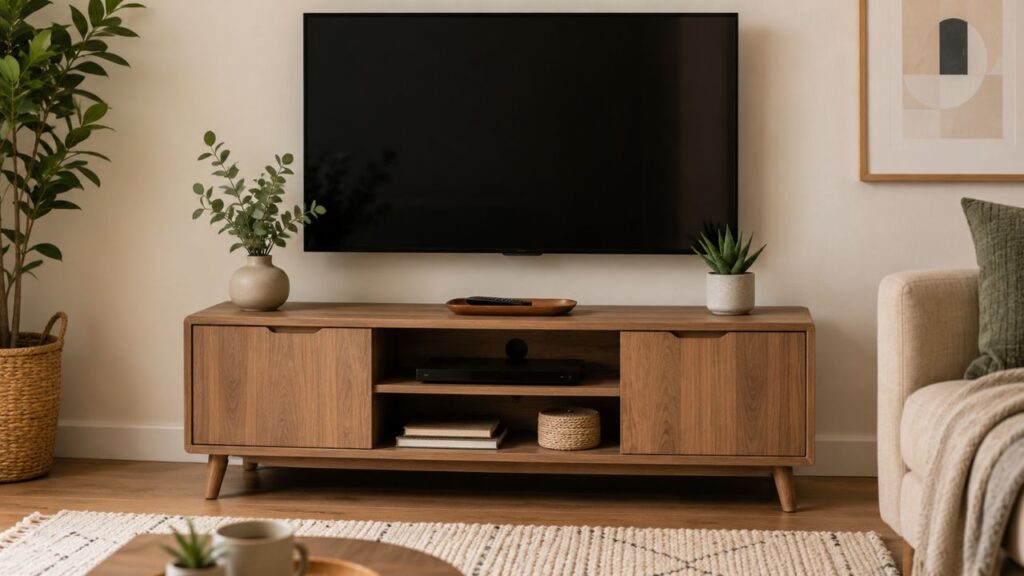
Why Small Media Cabinets Work So Well
A compact cabinet creates a visual base for the television without filling the entire wall. It can also store equipment that would otherwise spread across nearby furniture.
Modern television furniture is available with open shelves, cupboards, drawers, adjustable shelving, soft-closing doors, and push-to-open fronts. This makes it possible to choose storage around the equipment rather than accepting a one-size-fits-all layout.
The practical advantages include:
- Less visible clutter
- Better cable organization
- Dedicated storage for electronics
- A clearer focal point
- More usable floor space
- Easier cleaning
- Better proportions in small rooms
A low cabinet can also make the wall appear wider, particularly when its finish is close to the wall colour.
Measure Before You Browse
The most common buying mistake happens before the cabinet is ordered: the shopper measures the wall but ignores the rest of the room.
You need more than one number.
Measure the Available Wall Width
Measure the uninterrupted space between doors, windows, radiators, curtains, built-in units, and adjacent furniture.
Do not plan for the cabinet to touch both sides of this space. A small amount of breathing room prevents the arrangement from looking tightly packed.
As a starting point, leave:
- Around 5 to 10 centimetres beside a cabinet in a very tight area
- Around 15 to 30 centimetres on each side when space allows
- Extra clearance near doors, curtains, and heating equipment
Painter’s tape is useful here. Mark the cabinet’s proposed width and depth on the floor before ordering. Walk around it, open the nearby door, pull out a chair, and check whether the pathway still feels natural.
Measure the Television’s Actual Width
Televisions are sold by diagonal screen measurement, not by total external width. A 55-inch model is not 55 inches wide.
Measure the television from its far-left edge to its far-right edge. When the TV stands on feet, measure the distance between the outermost points of those feet too.
The cabinet should be wide enough to support the television safely. A slightly wider cabinet usually looks more balanced than one that ends inside the television’s outer edges.
Check the Cabinet Depth
Depth matters in narrow rooms because furniture projects into the walking area.
A cabinet may be advertised as compact because it is narrow, while still being unusually deep. Check the full assembled depth, including handles and doors.
Also measure:
- The depth of game consoles
- The depth of an AV receiver
- Router size
- Cable connectors
- Space required for ventilation
- Door-opening clearance
A device may physically fit on a shelf but still be impractical if cables bend sharply against the rear panel.
Media Cabinet Size Guide
The following ranges are planning references rather than fixed rules.
| Television size | Suggested cabinet width | Suitable room type |
|---|---|---|
| 32–40 inches | 90–120 cm | Bedroom, studio or small sitting area |
| 43–50 inches | 110–140 cm | Apartment living room or guest room |
| 55 inches | 130–160 cm | Compact lounge or family room |
| 65 inches | 150–180 cm | Medium wall with limited depth |
| Wall-mounted TV | Based on visual balance | Any room with flexible storage needs |
The position of the television matters as much as cabinet width. Samsung’s TV sizing guidance uses viewing distance as a starting point and notes that screen size is measured diagonally. One of its current guides suggests multiplying screen size in inches by 1.2 to estimate a viewing distance for a 4K television. Treat this as a starting reference rather than an absolute rule, since room arrangement and personal preference also matter.
Choose the Right Cabinet Type
Low Media Console
A low console suits wall-mounted televisions and makes a short wall feel wider.
It works well when you want:
- A calm horizontal shape
- Drawers for concealed storage
- Space above for artwork or a television
- A contemporary look
- Less visual weight
Low cabinets are also useful in bedrooms where the television must be visible from the bed.
Narrow TV Stand
A narrow stand is designed for rooms where every centimetre of depth matters.
Look for:
- Sliding doors instead of hinged doors
- Recessed handles
- Shallow shelves
- Rear cable openings
- Raised legs for easier cleaning
Sliding doors are particularly useful when a coffee table, bed, or chair sits close to the cabinet.
Corner Media Cabinet
A corner unit may work in an awkward room, but it should be chosen carefully. Some corner designs consume more floor area than expected because of their triangular rear section.
Before buying, tape the complete footprint onto the floor. Do not rely only on the width shown across the front.
Floating Media Cabinet
A wall-mounted cabinet leaves the floor visible, which can make a compact room feel less crowded.
It also allows:
- Easier floor cleaning
- Flexible mounting height
- A visually lighter appearance
- Concealed cable routes
- Space for baskets or occasional seating below
The wall structure and mounting system must support the loaded cabinet. Follow the manufacturer’s instructions and use fixings suited to the wall type.
Tall Media Storage Unit
A tall unit uses vertical space, but it has more visual weight and greater tip-over risk than a low console.
The U.S. Consumer Product Safety Commission advises anchoring furniture with drawers, doors, and shelves to the wall. It also recommends placing televisions only on sturdy furniture designed to hold them and securing both furniture and televisions against tip-over.
Open Shelves, Doors or Drawers?
The best storage layout depends on what you intend to place inside.
Open Shelves
Open shelving provides easy access and better natural airflow.
It is useful for:
- Game consoles
- Streaming devices
- AV receivers
- Wi-Fi routers
- Frequently used controllers
The disadvantage is visual clutter. Every cable and device remains visible.
Cabinet Doors
Doors hide mixed items and create a cleaner façade.
They are best for:
- Board games
- Spare cables
- Manuals
- DVDs
- Accessories
- Items used occasionally
Solid doors can interfere with remote-control signals and limit ventilation. Slatted, mesh, glass, or perforated fronts often work better for active electronics.
Drawers
Drawers organize small objects that become messy on shelves.
Use them for:
- Remotes
- Charging cables
- Headphones
- Batteries
- Gaming accessories
- Cleaning cloths
Avoid storing powered equipment in a tightly enclosed drawer unless the cabinet is specifically designed for that purpose.
The Best Storage Formula for Most Homes
For many compact rooms, the most practical design is:
- One open shelf for active electronics
- One drawer for small accessories
- One closed compartment for visual clutter
- A rear cable opening
- Adjustable shelving
- Enough floor clearance for cleaning
This mixed arrangement keeps equipment accessible without making the room look like a technology display.
Choosing Materials That Last
Solid Wood
Solid wood feels substantial and can often be repaired or refinished. It suits traditional, Scandinavian, farmhouse, and mid-century interiors.
Its disadvantages include:
- Higher price
- Greater weight
- Natural movement caused by humidity
- Variation in colour and grain
Wood Veneer
Veneer uses a thin layer of real wood over an engineered core. A well-made veneer cabinet can offer the appearance of solid timber at a lower cost and with greater dimensional stability.
Inspect edge finishing carefully. Poor-quality veneer may chip or separate around corners.
MDF
Medium-density fibreboard provides a smooth surface for paint and modern finishes. It is commonly used for flat cabinet doors and clean-lined furniture.
MDF can perform well indoors but should be protected from standing water and damaged edges.
Particleboard
Particleboard is often the most affordable option. Quality varies considerably.
Check:
- Panel thickness
- Edge banding
- Hardware quality
- Back-panel strength
- Weight capacity
- Warranty
- Assembly method
A low price is not a problem by itself. Weak joinery and poor-quality fasteners are the greater concern.
Metal
Powder-coated steel frames suit industrial and modern rooms. Metal offers strength without requiring thick panels, which can help a cabinet look visually lighter.
Check whether shelves are metal, glass, or engineered wood, since the frame alone does not determine total weight capacity.
Glass
Glass shelves and fronts reflect light, but they show dust, fingerprints, and cables.
Tempered safety glass is preferable for furniture use. Check the manufacturer’s stated load rating before placing heavy equipment on it.
Cable Management: The Feature People Notice Too Late
A small media cabinet can still look untidy when the cables behind it form a visible knot.
Good cable management begins with the cabinet design.
Look for:
- Rear cable holes
- Removable back panels
- Cable channels
- Ventilated openings
- Internal power-strip space
- Grommets with smooth edges
Before arranging equipment, label both ends of each cable. Group power cables separately from signal cables where practical, and avoid tightly coiling excess cable around power adapters.
Keep enough slack to pull a device forward for maintenance without disconnecting everything.
Ventilation for Consoles and Media Equipment
Electronic equipment produces heat. A cabinet that hides devices beautifully can shorten their usable life if warm air has nowhere to escape.
Open shelves provide the simplest ventilation. Closed cabinets should include vents or perforated sections, particularly when holding game consoles, amplifiers, receivers, or several powered devices.
Do not press equipment directly against the rear panel. Follow the clearance guidance supplied with each device.
A useful test is simple: after the equipment has been operating for a while, check whether the compartment feels unusually hot. Persistent heat suggests that airflow needs improvement.
Styling a Small Media Cabinet in a Living Room
Treat the cabinet as part of the room’s furniture system rather than as an isolated technology stand.
In an open-plan home, repeat one or two materials already present in the room. A walnut cabinet can echo a dining table. A black metal frame can relate to lighting fixtures. A white cabinet can blend into a pale wall and reduce visual weight.
Do not cover the entire top with decorative objects. Leave negative space around the television and keep tall items away from the screen edges.
A compact lamp, a small tray, or one plant is usually enough.
Using a Small Media Cabinet in a Bedroom
A bedroom television setup needs to work with sleep furniture and circulation.
The media cabinet should not compete with the bedside table or make the route around the bed feel narrow. Choose a finish that relates to the room without forcing every furniture piece to match exactly.
When the room already contains large nightstands, a light-looking media unit with legs can prevent the lower half of the room from feeling overloaded.
A single night stand and a narrow media console can share a similar wood tone while differing in shape. That approach feels coordinated without resembling a showroom package.
A nightstand with drawers provides hidden personal storage, while the media cabinet can handle entertainment equipment. Separating those functions keeps both pieces easier to organize.
In a larger bedroom with matching night stands, choose a media cabinet with simpler fronts. Too many repeated drawers and handles may make the room feel visually busy.
Slim side tables for bedroom layouts often suit an equally shallow media cabinet. Measuring the projection of every piece helps preserve a comfortable walkway.
A coordinated nightstand set does not require a matching television cabinet. Repeating one detail, such as oak grain, black legs, or rounded corners, is usually enough.
A bed frame with nightstands already creates a strong visual unit. In that case, the media cabinet should remain restrained and avoid heavy decorative detailing.
Think about the full relationship between the bed and nightstand, not only the empty wall opposite them. A television cabinet that looks small in isolation may still crowd the room once all pieces are considered.
The ideal position for a nightstand next to bed furniture leaves enough space to open drawers and reach switches. Apply the same practical test to media cabinet doors and drawers.
When planning a nightstand bed arrangement in a studio, one low cabinet may serve as media storage, book storage, and a room divider without rising high enough to block light.
An ikea nightstand can pair with a media cabinet from a different collection when the finishes are close. Exact matching is less important than consistent proportions and hardware.
The same principle applies to an ikea bedside table: use repeated colour or material cues rather than buying every item from one range.
A complete bed frame and nightstand set may already dominate the bedroom. A wall-mounted media cabinet helps reduce the amount of furniture sitting directly on the floor.
A bed frame with side tables often creates a wide horizontal composition. A low media unit on the opposite wall can balance it without introducing a competing vertical shape.
Rooms furnished with a bed with side tables benefit from clear walking routes. Mark the media cabinet’s depth with tape before ordering to confirm that drawers and doors can open fully.
A coordinated bedframe and nightstand set tends to look formal. A media cabinet in a similar finish but with plain fronts can soften the arrangement.
A bed nightstand set with raised legs pairs naturally with a raised media cabinet. Repeating the visible floor gap makes separate pieces feel related.
With a bed frame and side table set, avoid adding a cabinet that repeats every decorative feature. One shared detail produces a more natural result than a perfect copy.
A bedroom set with 2 nightstands often consumes significant visual and physical space. Choose the smallest media cabinet that accommodates the television safely and stores only the equipment used in that room.
Safety Should Not Be Treated as an Optional Extra
Small furniture is not automatically stable.
A cabinet can tip when drawers or doors are opened, when a child climbs on it, or when a television is too large for the top surface. The CPSC advises anchoring televisions and furniture, using a sturdy low base, pushing an unmounted television back as far as possible, keeping cords out of reach, and placing heavier items on lower shelves.
Before use:
- Confirm the cabinet’s stated weight capacity
- Check that the television feet fit completely on the top
- Install the supplied anti-tip hardware
- Anchor the television when it is not wall-mounted
- Keep heavy equipment low
- Do not place toys or tempting objects on high shelves
- Route cords away from children and walkways
- Recheck fasteners after assembly
A good media cabinet should make the room safer and easier to use, not simply more attractive.
Small Media Cabinet Buying Checklist
Before ordering, confirm all of the following:
| Question | Why it matters |
|---|---|
| Is the cabinet wider than the television or its feet? | Supports safe placement and visual balance |
| Is it shallow enough for the room? | Protects walking space |
| Are shelves deep enough for equipment and plugs? | Prevents bent cables and poor fit |
| Does it have ventilation? | Reduces trapped heat |
| Are there cable openings? | Keeps wires controlled |
| Can doors and drawers open fully? | Prevents daily frustration |
| Is the load capacity stated? | Helps avoid structural failure |
| Is anti-tip hardware included? | Improves household safety |
| Can the floor be cleaned beneath it? | Makes maintenance easier |
| Will it still work if the TV changes? | Extends the cabinet’s useful life |
A good small media cabinet is not simply a shorter or narrower television stand. It is a carefully proportioned storage unit that responds to the television, room dimensions, equipment, cable routes, airflow, safety needs, and surrounding furniture.
Measure the whole room, not just the empty wall. Choose storage based on what you own. Check the cabinet’s weight rating and ventilation. Most importantly, avoid sacrificing safe television support simply to gain a few extra centimetres of floor space.
How to Match a Small Media Cabinet to Your Interior Style
A compact media cabinet should solve practical problems first, but appearance still matters. The cabinet sits beneath or near one of the room’s strongest visual features: the television. That position naturally draws attention.
The safest design approach is to choose a cabinet that supports the room’s existing style without copying every other piece of furniture.
Modern Minimalist
A minimalist media cabinet usually has:
- Flat cabinet fronts
- Hidden or recessed handles
- A low horizontal profile
- Limited decorative detailing
- Neutral colours
- Concealed storage
White, soft grey, matte black, pale oak, and walnut are common choices.
Minimalist furniture works especially well in compact rooms because plain fronts create less visual noise. A cabinet with push-to-open doors may also appear narrower because there are no projecting handles.
The weakness of some minimalist cabinets is that appearance takes priority over ventilation. Check the rear panel and door construction before placing active electronics inside.
Scandinavian
Scandinavian-style media cabinets often combine pale wood, simple lines, rounded corners, and raised legs.
This style suits small rooms because it feels visually light. Visible floor space below the cabinet can make the room appear less crowded and allows easier cleaning.
Look for:
- Light oak or ash finishes
- White and wood combinations
- Tapered legs
- Simple drawer pulls
- Soft edges
- Practical storage
A Scandinavian cabinet can coordinate naturally with a bedside table in a nearby open-plan sleeping area without requiring both pieces to come from the same collection.
Mid-Century Modern
Mid-century media cabinets typically use warm wood tones, tapered legs, sliding doors, and long horizontal proportions.
This style is useful for small rooms because sliding doors do not need extra floor clearance. Walnut and teak-inspired finishes can also make inexpensive engineered furniture look warmer and more substantial.
A row of matching nightstands may make a bedroom look overly coordinated if the media cabinet copies them exactly. Choose a related wood tone while changing the cabinet-front style.
Industrial
Industrial media cabinets combine wood-look shelves with black steel frames or mesh doors.
They are well suited to:
- Loft apartments
- Gaming spaces
- Casual living rooms
- Modern masculine interiors
- Mixed-material furniture schemes
Mesh doors allow remote-control signals and airflow to pass through more easily than solid doors. Open metal frames also reduce visual weight, although exposed cables require careful organization.
A simple industrial cabinet can balance a wooden night stand by repeating only the black hardware or frame detail.
Traditional
Traditional media cabinets tend to include framed doors, moulding, decorative feet, or classic hardware.
These details can make a small cabinet look heavier, so proportion matters. Choose shallow moulding and restrained handles rather than ornate carving.
A traditional nightstand with drawers can pair with a media cabinet featuring simple framed doors, provided the cabinet does not become too visually dense.
Japandi
Japandi interiors combine Japanese simplicity with Scandinavian warmth.
Suitable cabinet features include:
- Low proportions
- Natural wood
- Slatted doors
- Rounded edges
- Soft neutral colours
- Minimal visible hardware
Slatted doors are especially useful because they conceal equipment while supporting airflow and remote signals.
If a room contains two matching night stands, a low Japandi cabinet can create balance through material and proportion rather than exact repetition.
How to Choose the Right Colour
Colour changes how large or heavy a cabinet appears.
Match the Wall for a Lighter Effect
A cabinet that closely matches the wall colour visually recedes into the room. This is useful when:
- The wall is narrow
- The television is large
- The room contains several other furniture pieces
- You want the screen to remain the focal point
White against a white wall is the most obvious example, but the same technique works with grey, beige, olive, navy, or painted custom cabinetry.
Choose Dark Colours for Definition
Black, charcoal, espresso, and dark walnut create stronger contrast.
A dark cabinet can help a black television blend into the arrangement, particularly when the wall is also deep in tone. On a pale wall, however, a dark unit may look visually heavier.
Use Wood for Warmth
Wood finishes soften the appearance of electronics.
Light wood feels casual and airy, while darker timber looks more formal. Wood is also flexible enough to work with neutral, green, blue, cream, terracotta, and black colour schemes.
Slim side tables for bedroom use can share the media cabinet’s wood family without matching the exact grain or shade.
Consider Two-Tone Cabinets
Two-tone furniture can make a cabinet appear less bulky.
Examples include:
- White cabinet with oak top
- Black frame with walnut doors
- Cream body with cane panels
- Wood cabinet with black legs
Two-tone finishes are particularly useful when you need to connect furniture from different parts of an open-plan room.
A coordinated nightstand set may use the cabinet’s secondary colour, such as black legs, rather than repeating the full finish.
Floating Versus Freestanding Media Cabinets
Both formats work in small spaces, but they solve different problems.
| Feature | Floating cabinet | Freestanding cabinet |
|---|---|---|
| Visual weight | Lighter | Usually heavier |
| Floor cleaning | Easier | Depends on leg height |
| Installation | Requires wall mounting | Usually simple assembly |
| Flexibility | Harder to move | Easier to reposition |
| Weight support | Depends on wall and fixings | Supported by floor |
| Cable concealment | Often better | Varies by design |
| Rental suitability | May require permission | Usually more suitable |
| Safety | Secure when installed correctly | Often requires anti-tip anchoring |
Choose a Floating Cabinet When:
- The television is wall-mounted
- Floor space needs to remain visually open
- You want hidden cable routes
- The wall can support the loaded unit
- You plan to keep the layout for several years
A room with a large bed frame with nightstands can feel furniture-heavy. A floating media cabinet leaves more floor visible and helps the opposite wall look lighter.
Choose a Freestanding Cabinet When:
- You rent the property
- You may rearrange the room
- Wall construction is uncertain
- You need easier installation
- The television sits directly on the cabinet
The relationship between the bed and nightstand may change when the bedroom is rearranged. A freestanding media cabinet gives you more flexibility than a permanently mounted model.
Doors, Handles, and Opening Clearance
Cabinet doors are often ignored during measuring.
A cabinet may fit between two walls but become difficult to use once its doors swing open. Measure the full door arc and consider nearby furniture.
Hinged Doors
Hinged doors provide full access but need open floor space.
They work best when:
- Nothing sits directly in front of the cabinet
- The doors are narrow
- The cabinet is shallow
- The hinges open wide enough for easy access
A nightstand next to bed furniture layout already needs drawer clearance. Do not let the media cabinet create another opening conflict across the same walkway.
Sliding Doors
Sliding doors save clearance and suit narrow rooms.
Their disadvantage is that only one side of the cabinet can be fully open at a time. Tracks can also collect dust.
A compact nightstand bed setup in a studio often benefits from sliding media-cabinet doors because there may be little room for hinged panels.
Drop-Down Doors
A drop-down door opens forward and can act as a temporary shelf.
Check that:
- The hinges are strong
- The door does not block the walkway
- Children cannot climb on it
- The hardware includes a controlled opening mechanism
Handle-Free Fronts
Push-to-open systems create a clean appearance but may show fingerprints.
Recessed handles offer a practical middle ground. They do not project into the room but are often easier to operate than touch-latch doors.
An ikea nightstand with simple fronts can coordinate with a handle-free media unit through clean geometry rather than identical construction.
Price Ranges and What You Usually Get
Prices vary by country, material, brand, and cabinet size, but most products fall into broad quality groups.
Entry-Level
Entry-level media cabinets commonly use particleboard, printed wood finishes, basic hardware, and lightweight back panels.
They can work well when:
- The television is small
- Equipment is lightweight
- The cabinet will not be moved often
- The room has low moisture
- Assembly is completed carefully
Check reviews for repeated complaints about sagging shelves, misaligned doors, and weak fasteners.
An ikea bedside table and an affordable media cabinet can still look polished when both are assembled correctly and styled with restraint.
Mid-Range
Mid-range cabinets often include:
- Thicker engineered panels
- Better edge finishing
- Improved hinges
- Adjustable shelves
- Stronger drawer runners
- Better cable management
- More realistic veneer or laminate
This is often the best category for buyers seeking a balance between cost, durability, and appearance.
A bed frame and nightstand set may already represent a major furniture purchase. Choosing a mid-range media cabinet can maintain quality without making the whole room unnecessarily expensive.
Premium
Premium cabinets may use solid timber, high-quality veneers, welded steel frames, custom joinery, soft-close hardware, and better finishing.
The higher price can be worthwhile when:
- The cabinet is a long-term purchase
- It is visible from several rooms
- It supports expensive equipment
- The design is difficult to replace
- Repairability matters
A bed frame with side tables in a premium finish can be matched with a well-made media cabinet through craftsmanship rather than buying from the same product family.
Common Mistakes to Avoid
Buying a Cabinet Narrower Than the Television
A cabinet that is noticeably narrower than the screen can look unstable and poorly proportioned. It may also fail to support widely spaced television feet.
Ignoring Weight Capacity
Do not assume that a cabinet can support a television simply because the screen fits on top.
Check:
- Maximum top-panel load
- Shelf load limits
- Drawer load limits
- Wall-mount limits for floating models
Measuring Only the Product Width
Depth, height, door clearance, cable space, and skirting boards can all affect fit.
A room with a bed with side tables may have less circulation space than the wall measurement suggests. Mark the complete furniture footprint before purchase.
Choosing Closed Storage Without Ventilation
A clean façade is not worth overheating electronic equipment.
Use open shelves, mesh panels, slatted doors, or purpose-made vents for active devices.
Forgetting Remote-Control Signals
Solid cabinet doors may block infrared signals. Test equipment before committing to a fully enclosed setup.
Possible solutions include:
- Open shelving
- Glass fronts
- Slatted doors
- Mesh panels
- An infrared repeater
Overfilling the Cabinet
A small cabinet should store necessary equipment, not become a general dumping area.
When a bedframe and nightstand set already includes substantial storage, reserve the media cabinet for electronics and related accessories.
Choosing Style Before Function
A beautiful cabinet can still be frustrating if the router loses signal, the console overheats, or the doors cannot open.
A bed nightstand set may inspire the cabinet’s finish, but the media unit still needs proper ventilation, cable access, and safe television support.
Hiding Power Strips in Unsafe Spaces
Power strips should not be packed tightly behind equipment or covered by objects that trap heat.
Follow manufacturer instructions and local electrical safety guidance. Damaged cords, loose plugs, and overloaded outlets should be addressed rather than hidden.
Real-World Small-Room Scenarios
Scenario 1: Studio Apartment
The room contains a sofa, a small dining table, and a television on one wall.
Best solution:
- Wall-mounted television
- Floating media cabinet
- One open electronics shelf
- One closed compartment
- Light wall-matching finish
- Concealed vertical cable channel
The cabinet should be shallow enough to protect the walkway between the sofa and dining area.
Scenario 2: Compact Bedroom
The bed occupies most of the room, with storage furniture on both sides.
Best solution:
- Low freestanding cabinet
- Sliding doors
- Shallow depth
- Raised legs
- Minimal decoration
- Television secured to the wall or cabinet
A bed frame and side table set already creates a strong furniture composition, so the media cabinet should use plain fronts and limited visual detail.
Scenario 3: Child’s Room
The room has a television, game console, books, and toys.
Best solution:
- Low, sturdy cabinet
- Wall anchoring
- Secured television
- Rounded corners
- Closed storage for accessories
- Ventilated console shelf
- Cords kept out of reach
Safety should influence every design decision.
Scenario 4: Guest Room and Home Office
The cabinet must hold a television, printer paper, cables, and occasional work supplies.
Best solution:
- Mixed drawer and cupboard storage
- Adjustable shelves
- Cable openings
- Neutral finish
- Compact footprint
- Labelled internal organizers
A bedroom set with 2 nightstands may already supply guest storage, allowing the media cabinet to focus on technology and office items.
How to Make a Small Media Cabinet Look More Expensive
A low-cost cabinet can look refined when assembled and styled carefully.
Improve the Hardware
Replacing basic handles is one of the simplest upgrades.
Choose hardware that relates to:
- Door handles
- Lighting
- Curtain rods
- Table legs
- Picture frames
Keep handle size proportional to the cabinet.
Correct Assembly Gaps
Uneven doors make furniture look cheaper than it is.
During assembly:
- Work on a flat surface
- Confirm the cabinet is square
- Tighten fasteners gradually
- Adjust hinges after installation
- Check drawer alignment
- Recheck after the cabinet is loaded
Hide Visible Cables
Even expensive furniture looks untidy when cables hang below or run diagonally across the wall.
Use:
- Paintable cable covers
- Cable clips
- Sleeves
- Labels
- Internal power-strip mounts
- Wall plates installed by qualified professionals where required
Use Fewer Decorative Objects
One plant, one tray, or a short stack of books is often enough.
Crowding the top surface makes a small cabinet look smaller and distracts from the television.
Add Soft Lighting
A small lamp or carefully installed bias light can reduce the harsh contrast between a bright television and a dark wall.
Avoid visible strips, dangling wires, or lighting that reflects directly on the screen.
Maintaining a Small Media Cabinet
Regular maintenance protects both the cabinet and the electronics inside it.
Weekly
- Dust open shelves
- Wipe the top surface
- Check ventilation openings
- Return remotes and controllers to storage
- Remove objects blocking airflow
Monthly
- Inspect cable connections
- Vacuum behind the cabinet
- Check for heat buildup
- Tighten loose handles
- Inspect wall anchors and anti-tip straps
Every Few Months
- Check shelf sagging
- Reconfirm television stability
- Inspect power cables for damage
- Clean vents on game consoles and receivers
- Review stored items and remove clutter
Use cleaning products recommended for the cabinet material. Excess water can damage MDF, veneer, and particleboard, particularly around exposed edges.
Quick Buying Formula
A practical small media cabinet should meet five tests:
- Fit: It works with the wall, walkway, doors, and surrounding furniture.
- Support: It safely holds the television and electronics.
- Storage: It contains the items used regularly without becoming overcrowded.
- Airflow: It allows heat to escape.
- Balance: It looks proportional to the television and room.
If a cabinet fails any one of these tests, keep looking.
Frequently Asked Questions
How wide should a small media cabinet be?
The cabinet should generally be at least as wide as the television and wide enough to support its feet completely. A slightly wider cabinet usually creates better visual balance. Measure the television’s actual external width rather than relying on its advertised diagonal screen size.
Can a media cabinet be smaller than the television?
It can be smaller when the television is securely wall-mounted, but the arrangement may look top-heavy. The cabinet should still be visually proportional to the screen and large enough for the connected equipment.
What is the best depth for a narrow media cabinet?
The best depth depends on the equipment. Shallow cabinets save floor space, but game consoles, receivers, plugs, and cable bends may require more room than expected. Measure the deepest device with its cables attached.
Are floating media cabinets safe?
They can be safe when installed correctly into a suitable wall using the manufacturer’s required fixings. Installation quality, wall construction, cabinet weight, and stored equipment all matter.
Can I put a game console inside a closed cabinet?
Only when the compartment provides adequate ventilation and the console manufacturer’s required clearances are maintained. Heat buildup is a sign that the cabinet needs more airflow.
What material is best for a small media cabinet?
Solid wood and high-quality veneer offer long-term durability, while MDF and particleboard can provide good value when properly constructed. The best choice depends on budget, expected load, humidity, and how long you plan to keep the cabinet.
Should a media cabinet match other furniture?
It does not need to match exactly. Repeating one or two details—such as wood tone, leg colour, shape, or hardware—is usually enough to create visual consistency.
Are open shelves better than cabinet doors?
Open shelves provide easier access and airflow, while doors hide clutter. A combination of open and closed storage is usually the most practical arrangement.
How can I hide cables behind a small TV cabinet?
Choose a cabinet with cable holes or removable back panels. Use clips, sleeves, labels, and paintable cable channels. Keep power connections accessible and avoid tightly packed adapters.
What type of media cabinet is best for a bedroom?
A low, shallow cabinet with sliding or handle-free doors often works well. It should not block walking paths, wardrobe doors, or access to the bed.
How do I stop a media cabinet from tipping?
Use the supplied anti-tip hardware, anchor the cabinet to the wall, place heavy items on lower shelves, and secure the television. Follow the cabinet and television manufacturers’ installation instructions.
Can a small media cabinet provide enough storage?
Yes, when its layout matches the user’s equipment. Adjustable shelves, one drawer, an open electronics shelf, and one closed compartment can hold more than a cabinet filled with poorly planned storage.
Final Takeaway
The best media cabinet small enough for a compact room is not automatically the narrowest or cheapest option. It is the cabinet that fits the television, protects walking space, supports electronic equipment, controls cable clutter, allows heat to escape, and remains stable during daily use.
Start with measurements. Check the television’s actual width, the cabinet’s complete depth, door clearance, shelf dimensions, cable space, and weight limits. Decide what must remain visible and what should be stored behind doors. Choose materials based on expected use rather than appearance alone.
Style still matters, but it should support the room instead of overpowering it. A low cabinet can widen the look of a narrow wall. A floating unit can reveal more floor. Sliding doors can solve clearance problems. Raised legs can reduce visual weight and make cleaning easier.
A successful cabinet does not need to hold everything you own. It needs to organize the equipment and accessories used in that specific room. When fit, safety, airflow, and proportion are handled properly, even a modest cabinet can make a small space feel calmer, cleaner, and far more considered.