
A bedroom is probably the most personal room in a home, yet it is surprisingly easy to design it as though its only purpose is holding a bed.
Good bedroom interior design considers what happens before you fall asleep, what happens when you wake up, how you move through the room, where everyday belongings accumulate, how daylight enters, where artificial lighting is needed, and how the room feels when you walk through the door.
A visually impressive bedroom can still be uncomfortable.
Perhaps the bed is too large for the floor plan. The wardrobe doors collide with a bedside table. There is nowhere to put yesterday’s clothes. The overhead light feels harsh at night. Decorative cushions take five minutes to remove before you can actually use the bed.
None of those problems can be solved by choosing another decorative vase.
A well-designed bedroom balances five things:
Comfort + function + proportion + atmosphere + personality
When those elements work together, even a modest bedroom can feel considered and comfortable.
This guide covers the practical side of bedroom design ideas, from room layouts and furniture dimensions to lighting, colors, storage, textures, air quality, sleep conditions, small bedrooms and common decorating mistakes.
The goal isn’t to create a showroom.
It’s to create a bedroom that works beautifully when nobody is taking photographs of it.
What Is Bedroom Interior Design?
Bedroom interior design is the planning and styling of a sleeping space to improve its function, comfort, appearance, storage, lighting and overall atmosphere.
It typically involves decisions about:
- bed placement,
- room layout,
- furniture size,
- storage,
- lighting,
- wall colors,
- flooring,
- window treatments,
- bedding,
- textiles,
- artwork,
- ventilation,
- acoustic comfort,
- personal accessories.
The strongest designs start with the room itself rather than a decorating trend.
A 10-by-10-foot bedroom requires a different approach from a large primary suite. A rental apartment has different limitations from a newly constructed home. A bedroom used partly as a home office requires different zoning from a room used only for sleep.
That context should influence every design decision.
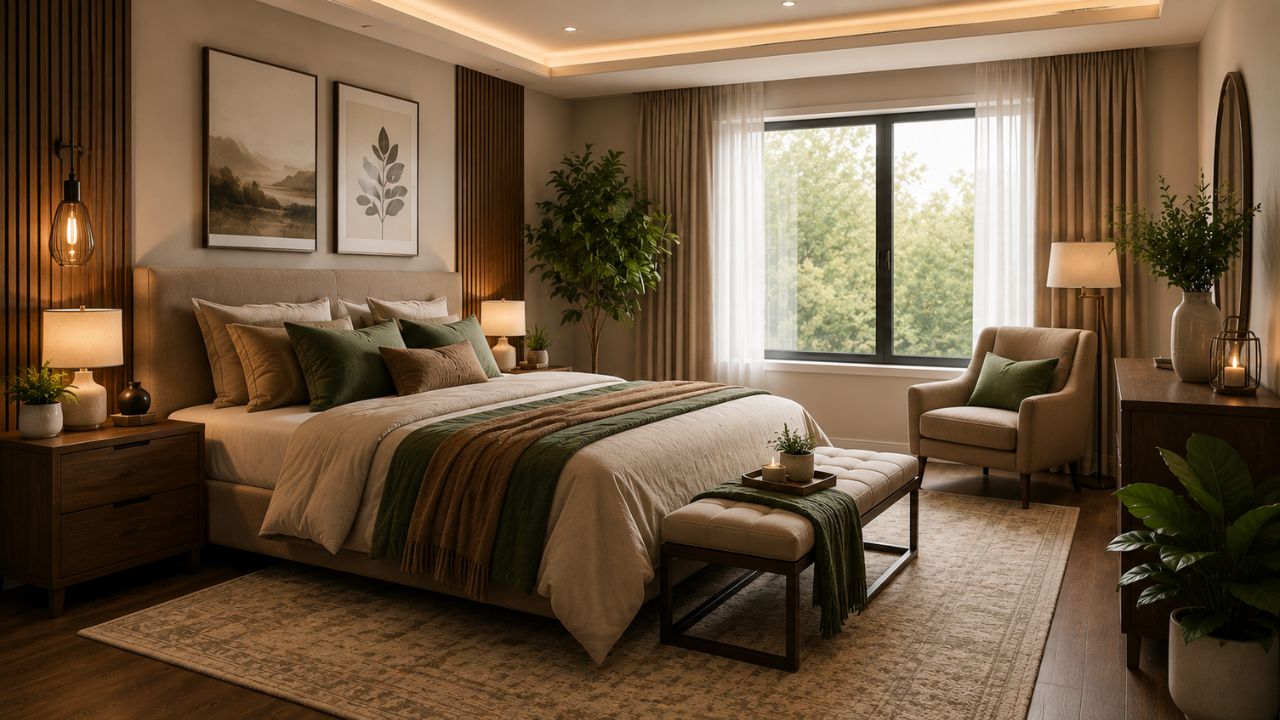
Start With How You Want the Bedroom to Feel
People often begin decorating by asking:
“What style should my bedroom be?”
A better first question is:
“How do I want this room to feel?”
Perhaps you want it to feel:
- quiet,
- warm,
- sophisticated,
- airy,
- intimate,
- minimal,
- natural,
- luxurious,
- bright,
- traditional,
- contemporary.
The answer gives you a filter for future decisions.
For example, if you want a calm bedroom, you might prioritize concealed storage, warm lighting, soft fabrics and a restrained color palette.
If you want an energetic contemporary bedroom, you might use graphic artwork, stronger contrast and cleaner furniture forms.
Your desired feeling should guide your bedroom decorating ideas, not the other way around.
1. Plan the Bedroom Layout Before Decorating
The layout has more impact on everyday comfort than almost any decorative decision.
Start by drawing a basic floor plan.
Record:
- room length,
- room width,
- ceiling height,
- window positions,
- door locations,
- wardrobe doors,
- electrical outlets,
- heating or cooling vents,
- radiators,
- architectural features.
Then place your largest item first.
In most bedrooms, that’s the bed.
Only after the bed position works should you add nightstands, wardrobes, dressers, desks, benches or chairs.
This approach creates stronger bedroom layout ideas because you’re working with real available space rather than imagining furniture independently.
2. Choose the Best Position for the Bed
The bed naturally becomes the visual center of most bedrooms.
Ideally, position the headboard against a solid wall with enough room to comfortably approach the bed.
Many symmetrical bedrooms place matching nightstands on both sides, but symmetry isn’t mandatory.
A narrow room may work better with one bedside table.
A studio apartment may require the bed against a side wall.
A large bedroom may allow a floating headboard or more unusual arrangement.
When considering bed placement ideas, check four practical issues:
Door clearance
Can every door open completely?
Wardrobe clearance
Can drawers and closet doors operate without hitting the bed?
Walking space
Can you reach both sides comfortably?
Window access
Can you open windows and curtains without climbing over furniture?
Beautiful layouts become irritating quickly when these basics are ignored.
3. Don’t Automatically Buy the Largest Bed That Fits
One of the most common bedroom mistakes is assuming a larger bed is always better.
It isn’t if everything else stops functioning.
A king-size bed can technically fit into many rooms while leaving almost no comfortable circulation.
That creates the appearance of a bed occupying a room rather than a bedroom containing a bed.
Think about the relationship between the mattress, bedside furniture, wardrobes and walking paths.
A slightly smaller bed can sometimes create space for:
- wider nightstands,
- a reading chair,
- better wardrobe access,
- a dresser,
- more comfortable circulation.
Good bedroom space planning considers the whole room.
4. Make the Headboard the Visual Anchor
A strong headboard gives the bed visual weight and helps establish the room’s style.
Popular options include:
- upholstered headboards,
- timber headboards,
- cane or rattan designs,
- leather panels,
- wall-mounted upholstered panels,
- painted headboard effects,
- architectural wall molding.
In a minimal room, the headboard can provide much of the necessary texture.
In a luxurious room, a taller upholstered design may create more drama.
For contemporary modern bedroom interior design, extended headboards that continue behind the nightstands can create a clean, hotel-inspired look.
Just keep scale in mind.
An oversized headboard can overpower a low-ceilinged bedroom, while a very small headboard can look lost against a large wall.
5. Build the Color Palette Around the Mood
There is no single “best” bedroom color.
There are only colors that suit different goals.
A useful bedroom color scheme often contains:
One dominant color + one supporting color + one accent
For example:
Cream + warm timber + olive green.
Or:
Soft gray + white + deep navy.
Or:
Terracotta + beige + dark brown.
Limiting the number of unrelated colors makes a room feel more settled.
Light Bedroom Colors
Light tones can make a bedroom feel bright and open.
Popular choices include:
- warm white,
- ivory,
- oatmeal,
- pale taupe,
- soft beige,
- muted sage,
- dusty blue.
They work particularly well in smaller rooms and spaces with limited daylight.
Dark Bedroom Colors
Dark colors aren’t automatically unsuitable for bedrooms.
Deep blue, charcoal, forest green, chocolate brown and muted burgundy can create intimacy.
The trick is understanding light.
A dark room needs thoughtful artificial lighting and enough textural variation so surfaces don’t disappear into one flat block.
A sophisticated bedroom color scheme can combine dark walls with lighter bedding, warm timber, brushed metal or natural fabric.
6. Use the 60-30-10 Color Idea as a Starting Point
A simple decorating framework assigns approximately:
- 60% to a dominant color,
- 30% to a secondary color,
- 10% to an accent.
Don’t treat those numbers as strict mathematics.
Their real purpose is visual hierarchy.
Perhaps the walls and carpet provide your dominant neutral.
The bed, curtains and larger furniture establish a secondary tone.
Lamps, cushions and artwork carry smaller accents.
This creates consistency without requiring everything to match.
7. Layer Bedroom Lighting Instead of Relying on One Fixture
Lighting is one of the clearest differences between a basic bedroom and a well-designed one.
A single overhead fixture gives you illumination.
It doesn’t necessarily give you atmosphere.
Effective bedroom lighting ideas combine several layers.
Ambient Lighting
This provides general illumination.
Examples include:
- ceiling fixtures,
- recessed lights,
- chandeliers,
- flush mounts.
Task Lighting
Task lights support specific activities.
Examples include:
- bedside reading lamps,
- desk lamps,
- dressing-table lights,
- wardrobe lighting.
Accent Lighting
Accent light contributes to atmosphere or highlights architectural details.
Examples include:
- wall sconces,
- picture lights,
- LED shelf lighting,
- concealed lighting.
You don’t need all three categories represented by expensive fixtures.
Two table lamps plus a ceiling light can already create much more flexibility.
8. Use Warm, Lower Light in the Evening
Bedroom lighting shouldn’t feel identical at 8 a.m. and 10 p.m.
Bright light is useful when dressing, cleaning or organizing.
Softer illumination makes more sense before bedtime.
The National Sleep Foundation notes that light is connected to circadian biology and recommends reducing bright and screen-related light during the nighttime period.
That makes dimmers particularly useful in bedroom lighting design.
If permanent dimmers aren’t practical, use lamps so you can switch off the main overhead fixture later in the evening.
Warm bedside lighting also creates a much more comfortable atmosphere than a harsh ceiling light shining directly overhead.
9. Make Bedside Lighting Easy to Reach
Bedside lamps should be practical before they are decorative.
You shouldn’t have to stand up to switch them off.
Choose among:
- table lamps,
- wall sconces,
- pendant lights,
- adjustable reading lamps.
Wall-mounted options are especially useful in small bedrooms because they free up nightstand space.
Pendant lights can produce a more architectural look while keeping surfaces clear.
For functional bedside lighting, consider where the light falls when you are actually lying or sitting in bed.
A beautiful lamp that shines directly into your eyes isn’t a successful choice.
10. Choose Nightstands Based on What You Actually Keep Beside the Bed
Nightstands shouldn’t be chosen only because they match the bed frame.
Think about what you need nearby.
Perhaps you regularly keep:
- a phone,
- book,
- glasses,
- water,
- medication,
- charger,
- lamp.
If you keep several objects there, drawers may be useful.
If you only need a phone and a glass of water, a small floating shelf might be enough.
Matching nightstands can create symmetry, but mixed furniture often produces more character.
The important thing is maintaining a comfortable relationship between mattress height and bedside surface height.
11. Create Storage Before Adding Decoration
Bedrooms accumulate clutter easily because they contain many personal possessions.
Clothing.
Bedding.
Shoes.
Books.
Accessories.
Chargers.
Laundry.
Cosmetics.
Solving storage early makes decorating much easier.
Useful bedroom storage ideas include:
- beds with drawers,
- lift-up storage beds,
- tall wardrobes,
- bedside drawers,
- built-in cabinetry,
- benches with storage,
- under-bed boxes,
- wall shelving,
- drawer organizers.
Closed storage often works particularly well because it reduces visual clutter.
12. Use the Space Under the Bed
The footprint beneath a bed is valuable.
Especially in a smaller bedroom.
Use it for items that need storage but not constant access, such as:
- seasonal clothing,
- spare blankets,
- luggage,
- extra pillows,
- occasional-use items.
A bed with integrated drawers creates a cleaner appearance than loose containers.
Lift-up beds can provide even more storage.
For small bedroom storage ideas, the bed is often the best place to start before adding another freestanding cabinet.
13. Take Wardrobes Upward
When floor area is limited, vertical space becomes more important.
Tall wardrobes make better use of room height than shorter freestanding units.
The highest shelves can hold:
- luggage,
- seasonal bedding,
- storage boxes,
- rarely worn clothing.
Frequently used clothing should remain at accessible heights.
This zoning principle keeps bedroom organization practical rather than trying to make every shelf equally accessible.
14. Mix Open and Closed Storage
Open shelving makes items easy to reach, but too much exposed storage can make a bedroom look busy.
Closed storage visually simplifies the room.
Try using closed cabinetry for ordinary belongings and a smaller amount of open space for:
- books,
- artwork,
- ceramics,
- photographs,
- carefully selected personal items.
Successful bedroom organization isn’t about hiding every possession.
It’s about controlling what the eye has to process when you enter the room.
15. Choose Curtains for Both Function and Appearance
Curtains influence light, privacy, acoustics, texture and the perceived proportions of a room.
Mounting curtains higher than the top of the window can draw the eye upward.
Extending the curtain rod beyond the window can allow the fabric to sit beside the glass when open, exposing more daylight.
For bedrooms, layering window treatments can be particularly useful.
A sheer layer provides daytime privacy.
A heavier curtain or blackout treatment helps control nighttime light.
The National Sleep Foundation recommends keeping bedrooms dark at night as part of a sleep-supportive environment.
That makes window treatments an important part of functional bedroom decor, not simply something used to finish the windows.
16. Choose Bedding for Comfort First
Your bedding occupies a large visual portion of the room, but its primary job is still comfort.
Start with:
- mattress comfort,
- pillows,
- sheets,
- duvet or comforter.
Then add decorative layers.
A practical bedroom bedding design might use:
- fitted sheet,
- duvet or comforter,
- two sleeping pillows,
- one or two decorative cushions,
- optional throw.
You don’t need ten cushions.
If styling the bed becomes a daily chore, the design isn’t serving you particularly well.
17. Mix Textures Instead of Buying More Decorations
Bedrooms often look flat when every surface has the same visual character.
Texture can solve this without adding clutter.
Combine materials such as:
- cotton,
- linen,
- wool,
- timber,
- boucle,
- velvet,
- rattan,
- ceramic,
- stone,
- brushed metal.
Imagine a neutral room with cream walls.
Now add a linen headboard, oak nightstands, wool rug, cotton bedding and ceramic lamps.
Nothing is especially colorful, but the room still feels layered.
This is one reason neutral bedroom design doesn’t have to feel boring.
18. Use Rugs to Add Warmth and Define the Bed
A rug can soften the bedroom visually and physically.
In rooms with hard flooring, it also gives you a warmer surface underfoot.
A common mistake is choosing a rug so small that it appears to float beneath only a tiny section of the bed.
Try to create a visible border around enough of the bed for the rug to feel intentional.
Possible approaches include:
- one large rug under the bed,
- runners along each side,
- a rug positioned beneath the lower portion of the bed.
Scale matters more than following a single formula.
19. Treat the Wall Behind the Bed as the Main Focal Point
Most bedrooms naturally direct attention toward the bed.
Use that.
The wall behind it can feature:
- artwork,
- paneling,
- wallpaper,
- paint,
- upholstered panels,
- timber slats,
- decorative molding.
For bedroom wall design, restraint usually produces stronger results than decorating every wall equally.
One intentional focal wall and three quieter walls can create better visual hierarchy than four competing surfaces.
20. Don’t Assume You Need an Accent Wall
Accent walls can work well, but they aren’t mandatory.
Sometimes painting the entire bedroom one color feels more cohesive.
This is particularly effective when using:
- warm neutrals,
- muted earthy colors,
- soft greens,
- dusty blues.
An accent wall makes the most sense when it supports an existing focal point rather than being added simply because the room feels unfinished.
21. Choose Artwork at the Correct Scale
One small picture above a king-size bed can look strangely disconnected.
One oversized piece may work much better.
Possible arrangements include:
- one large artwork,
- two balanced prints,
- three related pieces,
- a controlled gallery grouping.
The artwork doesn’t have to match every color in the bedroom.
It should feel connected to the overall mood.
For sophisticated bedroom wall decor, choose art because you enjoy living with it rather than because it matches a cushion perfectly.
22. Use Mirrors Where They Provide a Real Benefit
Mirrors are useful for:
- dressing,
- reflecting light,
- creating visual depth,
- filling narrow wall areas.
A full-length mirror near the wardrobe is practical.
A decorative mirror opposite a pleasing view can make the room feel more open.
Mirrored wardrobe doors may work in very small bedrooms, although they create a stronger visual presence than plain doors.
Use mirrors intentionally rather than placing them on every available wall.
23. Design a Small Bedroom Around Priorities
Small bedrooms aren’t necessarily difficult to decorate.
They simply offer less tolerance for unnecessary furniture.
Start by deciding what the room genuinely needs.
For many people:
Bed → clothing storage → bedside surface → lighting
Everything else is optional.
Effective small bedroom interior design might replace:
- bulky nightstands with floating shelves,
- wide dressers with tall storage,
- floor lamps with wall lights,
- decorative benches with under-bed storage,
- swing-door wardrobes with sliding alternatives.
The goal isn’t filling every centimeter.
It’s protecting enough open space for the room to feel comfortable.
24. Use Furniture With Visible Floor Underneath
Raised furniture can make compact bedrooms feel visually lighter.
Examples include:
- beds on legs,
- floating nightstands,
- wall-mounted storage,
- slim-legged dressing tables.
Seeing more continuous flooring creates less visual blockage.
This is a useful technique for small bedroom interior design, but don’t make every piece extremely lightweight.
A bedroom still needs visual grounding, usually provided by the bed.
25. Create a Comfortable Primary Bedroom
A larger primary bedroom presents a different problem.
Too little furniture can make it feel unfinished.
Instead of filling unused areas randomly, create functional zones.
A master bedroom design might include:
Sleep zone
Bed, headboard and nightstands.
Dressing zone
Wardrobes, dresser and mirror.
Seating zone
Chair and side table.
Vanity zone
Dressing table and lighting.
Work zone
Desk, only if genuinely necessary.
Large bedrooms benefit from thoughtful grouping rather than furniture spread evenly around the perimeter.
A successful master bedroom design should still feel restful rather than functioning like five different rooms competing for attention.
26. Modern Bedroom Design: Keep the Lines Clean, Not the Room Empty
People often confuse modern design with minimal possessions.
They’re not the same thing.
Modern bedroom design usually emphasizes:
- simple furniture forms,
- clean visual lines,
- restrained ornament,
- integrated lighting,
- functional storage,
- controlled material palettes.
Warm timber, upholstered furniture and textured fabrics can prevent a clean-lined room from becoming sterile.
Contemporary interiors often mix these elements with concealed storage and subtle architectural detailing.
A strong modern bedroom design feels intentional rather than bare.
27. Minimalist Bedroom Design: Remove Friction, Not Personality
Minimalism works particularly well in bedrooms because reducing visual noise can create a calmer atmosphere.
But minimalism doesn’t mean removing everything meaningful.
Good minimalist bedroom design prioritizes:
- fewer decorative objects,
- concealed storage,
- clear surfaces,
- simple furniture,
- quality materials,
- intentional artwork.
Keep personal photographs.
Keep books you genuinely read.
Keep the chair you love.
Remove objects that occupy space without contributing function or enjoyment.
That’s a much healthier way to approach minimalist bedroom design than trying to imitate an empty showroom.
28. Luxury Bedroom Design Is Mostly About Material and Proportion
Luxury isn’t created by covering every surface with gold.
Many expensive-looking bedrooms are surprisingly restrained.
Common characteristics of luxury bedroom design include:
- generous headboards,
- layered lighting,
- high-quality textiles,
- substantial curtains,
- balanced furniture,
- carefully scaled artwork,
- tactile materials,
- uncluttered surfaces.
Lighting is particularly important.
Hotels rarely depend on one ceiling bulb.
They combine bedside lamps, concealed lighting, wall fixtures and ambient illumination.
You can borrow the same principle at home without copying the entire hotel aesthetic.
Good luxury bedroom design feels comfortable before it feels impressive.
29. Consider Bedroom Temperature as Part of the Design
Interior design isn’t purely visual.
Temperature strongly affects comfort.
The National Sleep Foundation reported in 2026 that many adults may find approximately 65–68°F comfortable for sleep, although personal preferences vary.
That doesn’t mean every bedroom needs to remain at one exact temperature.
Instead, consider how design choices influence heat.
Heavy bedding can trap warmth.
Direct sunlight can heat a west-facing room.
Poor airflow can make a small bedroom uncomfortable.
Fans, shading, breathable bedding and appropriate heating or cooling strategies deserve consideration when planning a comfortable bedroom design.
30. Pay Attention to Indoor Air Quality
A bedroom needs to breathe as well as look good.
The U.S. Environmental Protection Agency says indoor air quality can be affected by furnishings, building materials, moisture, household products and ventilation. The EPA recommends controlling pollution sources, improving ventilation when appropriate, and using filtration or air cleaning as a supplemental strategy.
It also recommends keeping indoor humidity below 60%, ideally around 30–50%.
In practical design terms:
- don’t block air vents with furniture,
- address dampness rather than hiding it,
- maintain HVAC systems,
- ventilate appropriately,
- consider material emissions during renovations.
The EPA notes that people spend about 90% of their time indoors, making indoor environmental quality worth considering alongside aesthetics.
31. Reduce Noise Where Possible
Bedrooms facing streets, neighboring apartments or active parts of a house can struggle with noise.
The National Sleep Foundation includes a quiet bedroom among its recommendations for creating a sleep-friendly environment.
Interior design can help somewhat.
Soft materials absorb more sound than bare hard surfaces.
Consider:
- rugs,
- curtains,
- upholstered headboards,
- fabric furniture,
- bookcases,
- wall hangings.
For shared walls, placing wardrobes or storage units against the noisy wall may create another physical layer between you and the sound source.
These measures aren’t substitutes for professional acoustic construction when severe noise is present, but they may improve everyday comfort.
32. Keep Technology From Becoming the Visual Focus
Modern bedrooms naturally contain technology.
Phones.
Chargers.
Smartwatches.
Televisions.
Speakers.
Laptops.
The problem arises when cables and screens dominate the design.
Use cable management, drawers and charging stations to reduce visual clutter.
Consider whether the television needs to be the first thing you see from the bed.
The National Sleep Foundation recommends reducing nighttime exposure to bright screens and electronic light as bedtime approaches.
Good design can support that habit simply by giving technology somewhere to go.
33. Add Plants Carefully
Plants can soften hard furniture lines and add natural texture.
Good locations include:
- beside a dresser,
- near a suitable window,
- on a wide shelf,
- in an otherwise empty corner.
Choose plants according to actual light conditions.
Don’t buy a high-light plant for a dark bedroom simply because it fits the aesthetic.
Artificial plants can provide visual greenery if caring for real plants isn’t practical.
Use plants as part of the room rather than turning the bedroom into an overcrowded indoor garden.
34. Create a Reading Corner Only If You’ll Use It
A beautiful bedroom chair often becomes a clothing rack.
If you genuinely read in your bedroom, create a small reading area with:
- comfortable chair,
- side table,
- lamp,
- optional footstool.
If you don’t, leave the floor space open.
Design for real habits.
That’s one of the most useful principles in bedroom interior ideas.
Furniture should support the life taking place inside the room, not the lifestyle portrayed in a catalog.
35. Don’t Put a Desk in the Bedroom Unless You Need One
Remote work has pushed desks into many bedrooms.
Sometimes that’s unavoidable.
If you need a bedroom office, make the work area visually distinct from the sleeping area.
Try:
- a narrow desk,
- secretary desk,
- wall-mounted desk,
- compact writing table.
At the end of the day, put away work materials.
A closed laptop and clear desk help signal that the room has changed function.
A desk you never use, however, simply takes away valuable bedroom space.
36. Use Symmetry Carefully
Symmetry feels naturally calm.
A bed centered on a wall with matching nightstands and lamps is an easy formula.
But perfect symmetry can sometimes feel too formal.
You might pair:
- matching lamps with different nightstands,
- identical nightstands with different accessories,
- one artwork with asymmetric decorative objects.
The structure remains balanced while avoiding the feeling of a furniture showroom.
37. Don’t Match Every Piece of Furniture
Buying the complete matching bedroom set is easy.
It can also make the room feel overly coordinated.
More natural bedroom furniture ideas often combine pieces with some relationship but not exact duplication.
For example:
Oak bed.
Painted nightstands.
Upholstered bench.
Black metal lamp.
They share compatible colors and proportions without looking as though they came from the same box.
Repeating one or two finishes elsewhere helps maintain cohesion.
38. Choose Furniture According to Scale
Every item affects the visual weight of the room.
A large upholstered bed needs enough surrounding space.
A tall wardrobe needs to relate to the ceiling height.
A tiny lamp can disappear on an oversized nightstand.
An enormous pendant can overpower a low ceiling.
When considering bedroom furniture ideas, look at relationships between pieces rather than judging each item separately.
Bedroom Furniture Comparison
| Furniture Piece | Best For | Space Requirement | Main Benefit |
|---|---|---|---|
| Storage bed | Small bedrooms | Medium | Hidden storage |
| Platform bed | Modern rooms | Medium | Clean appearance |
| Floating nightstand | Tight rooms | Low | Frees floor area |
| Chest of drawers | Clothing storage | Medium | Accessible drawers |
| Tall wardrobe | Limited floor space | Medium | Uses vertical space |
| Storage bench | Larger bedrooms | Medium | Seating + storage |
| Reading chair | Spacious rooms | High | Creates relaxation zone |
| Dressing table | Primary bedrooms | Medium | Dedicated grooming area |
| Wall desk | Multipurpose rooms | Low | Compact workspace |
Bedroom Style Comparison
| Style | Typical Colors | Materials | Overall Feel |
|---|---|---|---|
| Modern | Warm neutrals, black, earthy tones | Wood, fabric, glass | Clean and comfortable |
| Minimalist | White, beige, gray | Wood, linen, plaster | Quiet and uncluttered |
| Scandinavian | White, pale wood, muted colors | Oak, wool, cotton | Light and relaxed |
| Japandi | Beige, brown, muted green | Timber, stone, linen | Calm and natural |
| Traditional | Cream, navy, warm brown | Timber, brass, upholstery | Formal and timeless |
| Farmhouse | Warm white, beige, earthy shades | Wood, linen, metal | Casual and inviting |
| Industrial | Charcoal, brown, black | Metal, timber, concrete | Strong and urban |
| Luxury Contemporary | Cream, taupe, deep accents | Stone, velvet, timber | Refined and polished |
Bedroom Interior Design Mistakes to Avoid
Even attractive rooms can become uncomfortable when planning comes second to appearance.
Buying the bed before measuring
Measure the room first.
Blocking wardrobe doors
Test their full opening radius before positioning nearby furniture.
Using only ceiling lighting
Bedrooms usually benefit from softer secondary light sources.
Choosing a rug that’s too small
Rugs should relate visually to the bed rather than floating independently.
Using too many decorative cushions
If they create daily frustration, simplify.
Filling every wall
Blank space helps establish hierarchy.
Ignoring storage
Clutter will eventually overpower decoration.
Making everything match
Coordination is useful. Exact repetition isn’t necessary.
Blocking ventilation
Never place furniture where it interferes with required vents or heating systems.
Copying trends without considering the room
A design that works in a 500-square-foot hotel suite may not work in a 100-square-foot bedroom.
A Practical Bedroom Interior Design Formula
When you’re unsure where to begin, work in this order:
Step 1: Measure
Create a basic floor plan.
Step 2: Position the bed
Find the best functional wall.
Step 3: Solve storage
Plan wardrobes, drawers and under-bed space.
Step 4: Add essential furniture
Nightstands, dresser or necessary workspace.
Step 5: Plan lighting
Combine general and bedside lighting.
Step 6: Select your palette
Choose dominant, secondary and accent colors.
Step 7: Add textiles
Bedding, rugs and curtains create softness.
Step 8: Add artwork
Create one or two intentional focal points.
Step 9: Add personality
Books, photographs and meaningful objects.
Step 10: Stop
The last step matters.
Not every empty surface needs another decoration.
Budget Bedroom Interior Design Ideas
You don’t need to replace your entire bedroom to make it feel different.
Start with changes that create the largest visual improvement for the lowest cost.
Free changes
- rearrange furniture,
- remove clutter,
- restyle shelves,
- relocate artwork,
- clear bedside surfaces.
Lower-cost upgrades
- new lampshades,
- cushions,
- curtains,
- bedding,
- paint,
- secondhand nightstands.
Mid-range upgrades
- rug,
- lighting fixtures,
- mirror,
- headboard,
- storage furniture.
Higher-cost changes
- mattress,
- bed frame,
- wardrobes,
- custom cabinetry,
- flooring.
For budget bedroom design, prioritize anything you physically interact with every day.
A comfortable mattress is more valuable than an expensive decorative object
A Real-World Bedroom Design Example
Imagine a 12-by-11-foot bedroom.
The owner wants a king bed, two large nightstands, dresser, desk, chair and storage bench.
Technically, most items can be squeezed inside.
But circulation becomes poor.
Wardrobe access is compromised.
The room feels crowded.
Instead, consider this arrangement:
Use a queen bed.
Choose two slim nightstands.
Replace the dresser with a taller chest of drawers.
Remove the bench.
Use a wall-mounted desk if remote working is necessary.
Mount bedside sconces instead of using large lamps.
The bedroom hasn’t physically changed.
But the usable space has.
This demonstrates a principle that gets overlooked in many bedroom design ideas:
A room can feel larger simply by giving each piece of furniture the correct amount of space.
Advanced Bedroom Design Insight: Design the Empty Space Too
Interior design isn’t only about objects.
The distance between objects matters just as much.
Think about the space:
- beside the bed,
- beneath a window,
- above the headboard,
- between the rug and walls,
- around a chair,
- between furniture pieces.
Designers often call this negative space.
It gives the eye room to rest and helps important objects stand out.
If every wall, shelf, floor area and corner contains something, the bedroom loses hierarchy.
A few deliberately empty areas can make modest furniture look more sophisticated.
Advanced Bedroom Design Insight: Think in Sightlines
Stand at the bedroom doorway.
What do you see first?
Ideally, it should be something intentional.
Perhaps:
- the bed,
- headboard,
- artwork,
- a well-framed window.
It probably shouldn’t be:
- laundry,
- cables,
- the side of a wardrobe,
- an overflowing storage shelf.
Then sit on the bed.
What is directly opposite you?
Consider each major sightline while planning bedroom decor ideas.
You spend more time looking from fixed positions in a bedroom than walking around it.
That makes those perspectives unusually important.
Advanced Bedroom Design Insight: Design Around Maintenance
An impressive bedroom that takes an hour to reset every morning isn’t particularly practical.
Ask:
Can I easily vacuum beneath this?
Can I clean this fabric?
Where will dirty clothes go?
Where will charging cables live?
Where do I put decorative pillows at night?
Can I reach the curtains?
Can I access the wardrobe?
These questions rarely appear in inspirational photographs, yet they have a huge influence on long-term satisfaction.
Good bedroom decor ideas should become easier to live with over time, not harder.
Featured Snippet: What Makes a Bedroom Look Well Designed?
A well-designed bedroom usually combines a clear furniture layout, balanced proportions, layered lighting, practical storage, coordinated colors, comfortable bedding and intentional decoration. The bed should act as the primary visual anchor while circulation paths remain clear and clutter is controlled.
Featured Snippet: How Can I Make My Bedroom Look More Expensive?
To make a bedroom look more expensive without a full renovation, use larger-scale artwork, floor-length curtains, layered lighting, high-quality bedding, fewer decorative objects, consistent finishes and appropriately sized furniture. Keeping surfaces organized often creates a stronger effect than buying more decor.
Frequently Asked Questions About Bedroom Interior Design
How do I start designing my bedroom?
Start by measuring the room and planning furniture placement. Position the bed first, solve storage second, then choose lighting, colors, textiles and decoration.
What is the best color for a bedroom?
There is no single best color. Warm whites, beige, muted green, dusty blue and soft gray are popular for calm interiors, while deep blue, green and brown can create a more intimate atmosphere.
How can I make my bedroom look luxurious?
Focus on good proportions, layered lighting, full-length curtains, quality bedding, substantial artwork, textural materials and uncluttered surfaces. Expensive-looking rooms usually contain fewer well-chosen items rather than more decoration.
How can I decorate a small bedroom?
Prioritize the bed and essential storage. Use tall wardrobes, wall-mounted lighting, floating nightstands, under-bed storage and appropriately scaled furniture to preserve floor area.
What furniture does a bedroom need?
Most bedrooms need a bed, accessible lighting and somewhere to store essential belongings. Nightstands, dressers, chairs, benches and desks should be added only when the room and the user’s routine justify them.
Should bedroom furniture match?
No. Furniture should coordinate in color, material, scale or style, but individual pieces don’t need to be identical.
What type of lighting is best for bedrooms?
A combination of ambient and task lighting generally works better than one ceiling fixture. Bedside lamps or wall sconces allow softer evening illumination.
How can I make a bedroom feel cozy?
Use warm lighting, layered bedding, curtains, rugs, tactile fabrics, timber, restrained colors and a small number of personal objects.
How can I make my bedroom look bigger?
Keep circulation clear, use appropriately scaled furniture, expose more visible floor, choose tall rather than wide storage, make good use of daylight and avoid filling every wall with furniture.
Should I put a rug under my bed?
A rug isn’t mandatory, but it can add softness, warmth and visual definition. Choose one large enough to visually relate to the bed rather than placing a tiny rug beneath it.
Where should mirrors go in a bedroom?
Position mirrors where they’re useful for dressing or where they can reflect natural light or an attractive view.
Are dark colors bad for small bedrooms?
No. Dark colors can create depth and intimacy when combined with good lighting, lighter textiles and visual contrast.
What is the biggest bedroom decorating mistake?
Buying furniture before properly measuring the room is one of the most expensive mistakes. Poorly scaled furniture can affect circulation, storage access and overall appearance.
How many colors should a bedroom have?
A restrained palette of roughly three main colors is an easy starting point. Variations in tone and texture can provide depth without introducing many unrelated colors.
What should go above a bed?
Popular choices include one large artwork, a pair or trio of prints, decorative molding, wallpaper, upholstered panels or nothing at all. The choice should relate to the scale of the bed and wall.
Final Bedroom Design Checklist
Before considering your bedroom finished, ask:
- Does the bed fit comfortably?
- Can every door open?
- Can wardrobe drawers operate freely?
- Are walking paths clear?
- Is there accessible bedside lighting?
- Is nighttime lighting softer than task lighting?
- Is there enough practical storage?
- Do everyday objects have designated places?
- Can curtains fully open and close?
- Is the room easy to clean?
- Are air vents unobstructed?
- Does the color palette feel connected?
- Is the artwork appropriately scaled?
- Are decorative objects controlled?
- Does the room feel comfortable when actually being used?
If most answers are yes, you’re probably much closer to a successful bedroom than someone who simply bought the latest furniture collection.
Great bedroom interior design isn’t defined by a particular style, expensive furniture or a perfectly staged bed.
It’s defined by how comfortably the room supports everyday life.
The best bedrooms have enough storage to stay manageable, enough light to support different activities, furniture that suits the room’s scale and materials that feel pleasant to live with.
They also leave enough room for personality.
A photograph.
A favorite book.
An unusual vintage nightstand.
Artwork collected while traveling.
A chair inherited from family.
Those details stop a carefully designed bedroom from feeling anonymous.
Use design principles to create structure, then allow your own taste to finish the room.
That’s how bedroom interior design becomes more than decorating.
It becomes a room that actually feels like home.