
The search intent behind white bedding sits between inspiration and purchase research.
Some readers are deciding what to buy. Others already own white sheets and want help styling them. Many are trying to recreate the crisp appearance of a boutique hotel without making the room feel cold or unfinished.
A complete answer therefore needs to cover:
- sheets, duvet covers, comforters, quilts, and pillowcases;
- cotton, linen, lyocell, silk, and synthetic fabrics;
- percale versus sateen;
- thread count;
- warm white versus bright white;
- layering;
- bedroom color combinations;
- seasonal bedding;
- washing and stain care;
- certifications;
- sizing;
- quality indicators;
- common buying mistakes.
That is exactly what this guide covers.
Why White Bedding Is Harder to Get Right Than It Looks
There is something deceptively simple about an all-white bed.
At first glance, it appears to require almost no design decisions. Pick white sheets, add a white duvet, place a few pillows on top, and you are finished.
In practice, great white bedding depends on texture, fabric, proportion, shade, layering, drape, and contrast.
This is why one white bed can look flat and inexpensive while another feels like a room in a carefully designed hotel.
The difference is rarely the color.
It is usually the details.
A crisp percale sheet creates a different effect from washed linen. A lightly quilted coverlet produces a different surface than a perfectly smooth sateen duvet. Bright optical white can feel sharp against creamy walls, while ivory-toned white can soften a traditional room.
Pottery Barn’s current styling guidance makes a similar point: white linens remain versatile partly because texture, embroidery, pleating, blankets, and accent pieces can change the character of an otherwise neutral bed.
That flexibility is the real strength of white.
What Is Included in White Bedding?
Before shopping for white bedding sets, it helps to understand what retailers mean by “bedding.”
The word can refer to almost everything placed on a mattress.
A complete bed may contain:
- fitted sheet;
- flat sheet;
- pillowcases;
- duvet insert;
- duvet cover;
- comforter;
- quilt;
- coverlet;
- blanket;
- decorative pillows;
- pillow shams;
- bed skirt.
Not every bedroom needs every layer.
In fact, using fewer, better-chosen pieces often produces a more polished result than piling every available textile onto the bed.
A practical everyday setup might consist of white bed sheets, two or four sleeping pillows, a duvet or comforter, and one lightweight throw.
A more formal guest bedroom might add European shams, a coverlet, and a decorative lumbar cushion.
The key is matching the number of layers to the climate, room style, and how much effort you are willing to put into making the bed each morning.
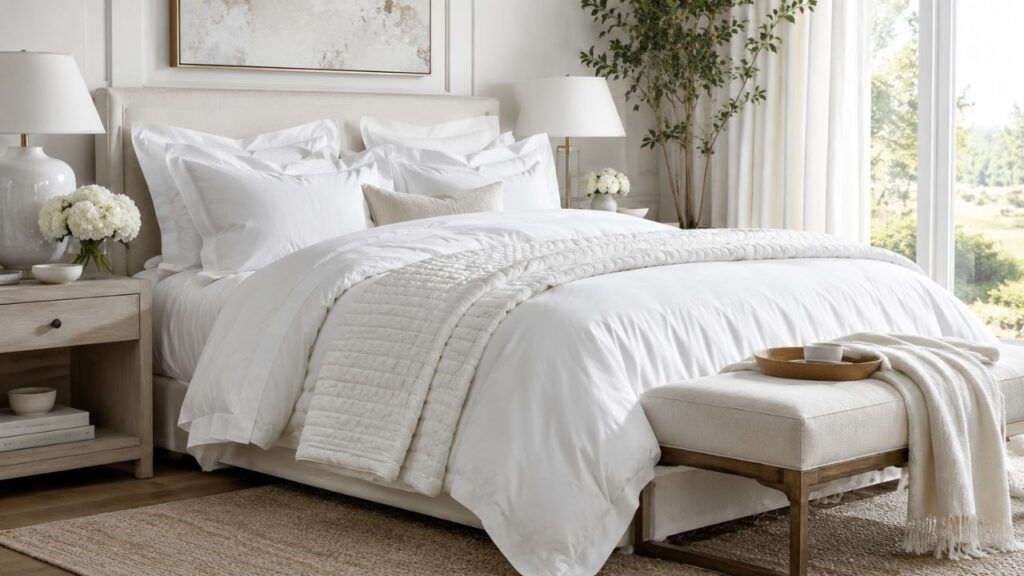
Quick Answer: How to Choose White Bedding
If you want a simple buying framework, follow this order:
- Choose your preferred fiber.
- Choose the weave based on how you like sheets to feel.
- Ignore exaggerated thread-count marketing.
- Select the right white tone for your room.
- Check mattress and duvet dimensions.
- Compare construction and finishing details.
- Look at care requirements before buying.
- Decide how many decorative layers you genuinely need.
- Check relevant textile certifications if those matter to you.
- Buy the best-quality core pieces your budget allows.
For most households, a strong starting combination is a quality white cotton fitted sheet, matching pillowcases, and a removable white duvet cover.
From there, you can build the look with texture instead of constantly replacing the basic bedding.
Why White Bedding Remains So Popular
White survives design trends because it does not force the rest of the bedroom in one direction.
Change the wall color and white still works.
Change the rug and white still works.
Replace dark furniture with oak and white still works.
Switch from modern to coastal styling and much of the bedding can stay.
That flexibility means white bedroom bedding can act as a visual foundation rather than the main decorative statement.
It can also make smaller bedrooms appear visually quieter because there are fewer competing colors across the largest soft surface in the room.
Still, white is not automatically calming.
A completely white bedroom with no variation in material, lighting, shape, or tone can feel sterile.
The fix is not necessarily more color.
Often, it is more texture.
White Bedding Material Comparison
The material matters more than almost any other bedding specification because it affects feel, drape, maintenance, warmth, and how the fabric ages.
| Material | Feel | Temperature | Maintenance | Best For |
|---|---|---|---|---|
| Cotton | Soft to crisp depending on weave | Versatile | Easy | Most households |
| Linen | Textured and relaxed | Airy | Moderate | Casual luxury |
| Lyocell/Rayon | Smooth and drapey | Often cool-feeling | Moderate | Silky feel |
| Silk | Very smooth | Temperature adaptable | High | Luxury use |
| Polyester | Smooth, variable | Less breathable than many natural fibers | Easy | Budget/easy care |
| Cotton blend | Depends on blend | Moderate | Easy | Practical everyday use |
Material names alone do not determine quality. Fiber length, yarn quality, weave, finishing, construction, and laundering also affect how a product feels and performs.
White Cotton Bedding: The Most Versatile Choice
For many buyers, white cotton bedding offers the easiest balance between comfort, care, availability, and style.
Cotton can be woven into very different fabrics.
It may feel crisp and matte.
It may feel smooth with a slight sheen.
It may be brushed for softness.
That means two packages labeled “100% cotton” can feel almost unrelated.
Current bedding testing guidance from the Good Housekeeping Institute stresses exactly this point: shoppers should assess fiber, construction, weave, fit, and care rather than relying on a single specification such as thread count. Its textiles experts have evaluated hundreds of sheet sets.
When Cotton Makes Sense
Consider cotton if you want:
- easy everyday laundering;
- lots of price choices;
- crisp or smooth weave options;
- broad availability;
- bedding that works with almost any design style.
High-quality white cotton bedding is especially useful if you like changing your bedroom décor because the same sheets can work underneath colored quilts, patterned throws, or neutral duvet covers.
White Linen Bedding: Relaxed Rather Than Perfect
White linen bedding creates a very different atmosphere.
Linen does not usually look freshly pressed for long.
That is part of the appeal.
Its natural creases and texture can make a bedroom feel relaxed, coastal, rustic, European, organic, or quietly luxurious depending on the rest of the room.
Instead of trying to create the perfectly smooth hotel bed, linen works well when you want the bed to look comfortable and lived-in.
Linen Works Particularly Well With
- oak furniture;
- plaster or limewash-style walls;
- natural rugs;
- warm white paint;
- woven baskets;
- stone;
- ceramic lamps;
- understated artwork.
A useful styling mistake to avoid is treating white linen bedding like formal sateen. Linen looks strongest when you allow some texture to remain instead of trying to remove every crease.
Percale vs Sateen: The Choice Most Buyers Should Understand
If you are buying cotton sheets, weave may tell you more about the sleeping experience than an impressive thread-count number.
Cotton Percale Sheets
Cotton percale sheets typically have a crisp, matte character associated with a simple plain weave.
They are popular among people who like bedding that feels fresh rather than silky.
Percale also suits the classic hotel-inspired look because it creates clean folds and a neat surface.
A white percale bed works particularly well in:
- warm climates;
- minimalist bedrooms;
- coastal interiors;
- modern bedrooms;
- hotel-style rooms.
Good Housekeeping’s current sheet-buying guidance describes percale as a crisp weave and treats fabric construction as a major buying consideration alongside fiber and fit.
If your idea of perfect sheets is a freshly made bed with a light, structured hand, cotton percale sheets are usually the first weave worth trying.
Cotton Sateen Sheets
Cotton sateen sheets have a smoother hand and generally more visible luster than percale.
The bed looks softer and more polished rather than crisp and matte.
Sateen can suit:
- glamorous bedrooms;
- upholstered beds;
- traditional interiors;
- luxury-inspired rooms;
- people who prefer smooth-feeling sheets.
The important distinction is that sateen is a weave, not a different species of cotton.
This seems basic, but it prevents a lot of confusion when shopping.
A buyer comparing cotton sateen sheets with percale should focus primarily on feel and sleeping preference rather than assuming one is universally higher quality.
Percale vs Sateen Comparison
| Feature | Percale | Sateen |
|---|---|---|
| Surface | Matte | Subtle sheen |
| Feel | Crisp | Smooth |
| Look | Fresh and tailored | Soft and polished |
| Good Match | Hotter rooms, hotel style | Luxury or traditional rooms |
| Wrinkling | More visible | Often visually smoother |
| Styling | Minimal, coastal, modern | Elegant, classic, romantic |
Neither weave is objectively better.
Choose based on what you enjoy touching every night.
What Is the Best Thread Count for Sheets?
The best thread count for sheets is not simply the highest number on the shelf.
Thread count describes the number of vertical and horizontal threads within a given area of woven fabric, but manufacturers can increase advertised numbers through multi-ply yarns and other construction choices.
That is why an extremely high number does not automatically mean better fabric.
Current Good Housekeeping buying guidance warns consumers against inflated thread-count marketing and recommends looking at fiber and fabric construction as well. Sleep Foundation makes a similar point in its 2026 hotel-sheet guidance, noting that unusually high advertised counts may be achieved using multi-ply yarns.
Instead of buying by number alone, compare:
- fiber quality;
- weave;
- yarn construction;
- hand feel;
- transparency;
- stitching;
- laundering instructions;
- brand transparency.
The best thread count for sheets is therefore the count that works well with good-quality fiber and the weave you prefer.
A well-made moderate-count percale can feel far better than a poorly made product marketed with a dramatic four-digit number.
White Bedding and the “Hotel Bed” Effect
The phrase hotel style bedding is used constantly in retail marketing, but the visual idea behind it is fairly simple.
A hotel-inspired bed usually has:
- white or nearly white sheets;
- controlled layering;
- clean edges;
- generous pillows;
- a substantial duvet;
- limited decorative clutter.
The look feels expensive because it is organized.
You do not need twelve pillows.
You need the right proportions.
A simple formula is:
Layer 1: fitted sheet
Layer 2: flat sheet, if you use one
Layer 3: duvet or comforter
Layer 4: two sleeping pillows per person
Layer 5: two larger shams
Layer 6: one throw or one decorative cushion
Luxury-hotel bedding discussions often emphasize moderate thread counts and high-quality cotton rather than extreme thread-count claims.
For convincing hotel style bedding, the duvet should also fill the cover properly. A flat, undersized insert can make even expensive linens look weak.
White Duvet Cover or White Comforter?
These products perform related jobs but are not identical.
White Duvet Cover
A white duvet cover is a removable textile shell placed over a separate duvet insert.
It allows you to wash the outer layer separately and switch the room’s appearance without replacing the fill.
This works well when:
- you want easier style changes;
- your duvet insert is expensive;
- you prefer washing the outer cover more often than the insert;
- you like layered European-style beds.
Check for internal ties or other mechanisms that help keep the insert positioned.
A good white duvet cover can become the visual anchor of the bedroom because it covers such a large area.
White Comforter
A white comforter combines the decorative outer textile and fill into one piece.
It can be easier to put on the bed because there is no insert to fit into a separate cover.
The tradeoff is laundering.
Large comforters can be difficult to wash in smaller domestic machines.
A white comforter makes sense when you want a straightforward all-in-one setup and have suitable cleaning options.
Duvet Cover vs Comforter
| Feature | Duvet Cover + Insert | Comforter |
|---|---|---|
| Construction | Two pieces | One piece |
| Style changes | Easy | Requires changing comforter |
| Washing | Cover usually easier | Entire piece washed |
| Initial setup | Slightly more effort | Simple |
| Customization | High | Moderate |
| Best for | Flexible bedrooms | Simple setups |
Luxury White Bedding: What Actually Creates a Premium Look?
Price does not automatically create luxury white bedding.
Some of the most effective visual improvements cost very little.
1. Use Different Textures
Combine smooth sheets with:
- quilted cotton;
- linen;
- waffle weave;
- matelassé;
- boucle accents;
- soft knit throws.
White-on-white works because texture creates shadows.
2. Use Larger Bedding
A duvet that barely covers the mattress can look skimpy.
A fuller drape often creates a more generous appearance.
3. Limit Decorative Pillows
Five thoughtfully placed pillows generally look more refined than fifteen unrelated cushions.
4. Steam Visible Pieces
You do not have to iron the entire bed.
Pay attention to the duvet edge, pillow fronts, and sections visible from the room entrance.
5. Hide Visual Clutter
The cleaner the bed palette, the more noticeable unrelated clutter becomes.
A white bed looks more premium when nightstands, cables, laundry, and random objects are controlled.
That is why convincing luxury white bedding is partly about the entire bedroom, not just the textile.
How to Style White Bedding Without Making It Boring
One of the most useful white bedding ideas is to stop thinking of white as one color.
There are cool whites, warm whites, cream whites, blue whites, gray whites, ivory whites, and natural undyed shades.
You can combine related whites without making everything match perfectly.
Try This Layering Formula
- crisp white fitted sheet;
- slightly warmer duvet cover;
- textured ivory coverlet;
- oatmeal throw;
- one dark or earthy accent cushion.
The room still reads as white.
It simply has more depth.
Another of the easiest white bedding ideas is using texture instead of print.
A waffle blanket, pleated duvet, embroidered sham, or chunky knit creates interest without weakening the quiet color scheme.
How to Style White Bedding in Different Bedroom Styles
Understanding how to style white bedding becomes easier when you start with the room’s design language.
Modern Bedroom
Use:
- smooth white duvet;
- low-profile bed;
- black accents;
- simple lamps;
- one textured throw;
- restrained artwork.
Avoid excessive ruffles or decorative cushions.
Minimalist Bedroom
Keep the palette narrow.
Mix bright white with soft stone, beige, pale oak, or muted gray.
Texture should do most of the decorative work.
Coastal Bedroom
Combine:
- white linen;
- natural timber;
- sandy beige;
- woven lighting;
- pale blue details;
- relaxed folds.
Traditional Bedroom
Try:
- sateen;
- embroidered pillowcases;
- tailored shams;
- upholstered headboard;
- warm metallic lamps;
- a quilted coverlet.
Farmhouse Bedroom
Use:
- washed cotton;
- linen;
- chunky throws;
- timber furniture;
- cream rather than blue-toned white.
Luxury Hotel Bedroom
Keep the sheets crisp and the palette controlled.
Use large pillows, balanced bedside lighting, a generous duvet, and perhaps one contrasting throw at the foot.
Once you understand how to style white bedding for the architecture of the room, the bed stops looking generic.
Which Shade of White Should You Choose?
Pure white is not always the most flattering option.
Look at your:
- wall paint;
- flooring;
- furniture;
- curtains;
- artificial lighting;
- amount of daylight.
Cool White
Works well with:
- gray;
- charcoal;
- black;
- chrome;
- cool marble;
- blue.
Warm White
Works well with:
- cream;
- beige;
- oak;
- walnut;
- brass;
- terracotta;
- warm stone.
Ivory and Off-White
Useful for:
- vintage rooms;
- traditional interiors;
- rustic bedrooms;
- spaces with warm artificial lighting.
If your walls are creamy and your bedding is intensely blue-white, the wall may suddenly appear yellow.
That is not necessarily a problem, but it should be intentional.
White Bedding With Beige and Cream
White and cream work especially well because the contrast is soft.
Dulux Pakistan currently recommends layering cream accents against crisp white bedding as one way to create a warmer, more comfortable bedroom palette.
For white bedroom bedding, consider pairing:
- white duvet;
- cream throw;
- taupe cushions;
- pale wood;
- natural jute;
- warm lighting.
This is one of the safest combinations when you want a neutral room without the colder feeling that can come from white-and-gray schemes.
A second option for white bedroom bedding is white plus warm brown. Walnut nightstands, leather accents, or tobacco-toned cushions can create enough contrast without overwhelming the room.
White Bedding With Dark Furniture
White is especially effective against:
- black beds;
- dark walnut;
- espresso furniture;
- charcoal upholstery;
- navy walls;
- deep green walls.
The contrast creates a strong focal point.
If the furniture is visually heavy, keep the bedding relatively simple.
Too much embroidery, piping, fringe, quilting, and decorative layering can make the room feel busy.
Instead, use one major texture and allow the contrast between light bedding and dark furniture to carry the design.
White Bedding With Color
White does not force you into an all-neutral bedroom.
It can be the quiet center of a colorful room.
Try:
White + Sage Green
Calm and natural.
White + Navy
Clean and classic.
White + Terracotta
Warm and earthy.
White + Dusty Blue
Soft and coastal.
White + Black
Graphic and modern.
White + Burgundy
Rich and traditional.
White + Blush
Soft without becoming overly sweet.
The advantage is flexibility.
Change the throw and two cushions, and the room can look completely different while the expensive base bedding stays.
White King Size Bedding: What to Check Before Buying
Buying white king size bedding is not just a matter of finding something labeled “king.”
Mattress dimensions and naming conventions vary across countries and sometimes across manufacturers.
Check the actual measurements listed on the package or product page.
For fitted sheets, measure:
- mattress width;
- mattress length;
- mattress depth.
Mattress depth becomes especially important if you use a topper.
For duvet covers, compare the duvet insert dimensions rather than assuming every king insert is identical.
A common styling trick with white king size bedding is using a duvet with generous side coverage so the bed feels fuller.
Just make sure the insert and cover dimensions remain compatible.
White Queen Bedding: Avoid the One-Size Assumption
The same rule applies to white queen bedding.
Read dimensions before ordering.
Two products carrying the same general size label can have different measurements, particularly across different markets.
Pay attention to:
- pocket depth;
- pillowcase dimensions;
- duvet width;
- duvet length;
- included pieces.
When buying white queen bedding as a set, check what “set” means.
Some include sheets.
Others include only a duvet cover and pillow shams.
A beautiful product becomes frustrating very quickly when you discover that the photographed pieces were not all part of the package.
Should You Buy White Bedding Sets or Separate Pieces?
White bedding sets are convenient because the components already coordinate.
They can also offer good value.
Still, buying everything separately has advantages.
Buy a Set If:
- you want fast coordination;
- you prefer identical whites;
- you are furnishing a guest room;
- you do not want to compare individual pieces.
Buy Separately If:
- you want different fabrics;
- you prefer a layered look;
- you want higher-quality sheets than the duvet set provides;
- you need unusual sizing;
- you want to replace pieces individually later.
A designer-style bed is often assembled rather than purchased as one complete package.
Organic Cotton Bedding: What Certification Actually Means
The word organic can be used carelessly in product marketing, so organic cotton bedding deserves a closer look.
Textile Exchange explains that raw cotton sold as organic must come from certified organic farming, but once the fiber leaves the farm, chain-of-custody systems such as the Organic Content Standard or Global Organic Textile Standard can help track it through subsequent processing.
GOTS certification covers textile processing and requires approved independent third-party certification across relevant parts of the supply chain. GOTS released Version 8.0 in March 2026.
If you are paying extra for organic cotton bedding, look for a specific certification claim you can verify rather than relying on vague phrases such as “natural,” “green,” or “eco-inspired.”
What Does OEKO-TEX STANDARD 100 Mean for Bedding?
OEKO-TEX STANDARD 100 is another label shoppers commonly see.
According to OEKO-TEX, STANDARD 100 indicates that textile components have been tested against a list of more than 1,000 potentially harmful substances. Bedding falls under Product Class 2 because it comes into direct contact with skin.
This certification answers a different question from organic certification.
GOTS deals with organic textile processing and associated environmental and social criteria.
OEKO-TEX STANDARD 100 focuses on testing the finished textile and its components for specified harmful substances.
Neither label tells you whether a sheet will feel crisp, silky, heavy, cool, or luxurious.
Those are separate buying decisions.
Be Careful With “Bamboo” Bedding Claims
This is one area where reading the fiber label matters.
The U.S. Federal Trade Commission states that textiles can only be described simply as bamboo when they are made directly from actual bamboo fiber. Fabrics manufactured as rayon or viscose using bamboo as the plant source should be identified accordingly, such as “rayon made from bamboo.”
That distinction matters when a retailer markets “bamboo” as automatically natural or environmentally superior.
The FTC has taken enforcement action over misleading bamboo-textile claims.
For buyers, the practical lesson is easy:
Read the fiber-content label rather than relying on the large marketing words on the front of the package.
Breathable Bedding: What Should Hot Sleepers Look For?
If you regularly feel too warm in bed, breathable bedding should take priority over decorative extras.
Look at:
- material;
- weave;
- fill weight;
- mattress protector;
- duvet insert;
- number of layers.
A light cotton percale sheet with a heavy synthetic duvet can still feel hot because the entire sleep system matters.
The same applies in reverse.
Expensive cooling sheets cannot completely compensate for an unsuitable mattress, very warm duvet, and multiple thick blankets.
When choosing breathable bedding, think from the mattress upward.
Reduce unnecessary layers before spending heavily on specialized products.
How to Create a Comfortable White Bed for Summer
Summer bedding should feel visually light and physically manageable.
Try:
- cotton percale sheets;
- lightweight duvet insert;
- linen cover;
- thin cotton blanket;
- fewer decorative layers.
Avoid placing a heavy throw across the entire sleeping area if it will simply be removed every night.
A folded throw at the foot can create the appearance of layering without adding much warmth where you sleep.
How to Style White Bedding for Winter
Winter gives you more freedom to build texture.
Add:
- quilted coverlet;
- heavier duvet;
- wool blanket;
- brushed cotton;
- knitted throw;
- velvet accent cushion.
Keep most layers within the same white-to-cream family if you want the bed to remain neutral.
A winter bed does not need to become dark simply because the weather changes.
How to Keep White Bedding White
The question how to keep white bedding white comes up almost as often as styling.
The first rule is less dramatic than any laundry hack:
Deal with marks early.
Do not allow makeup, food, body oils, or spills to remain on white textiles for long periods if the care label allows prompt cleaning.
Practical Habits
- Follow the manufacturer’s care label.
- Separate white bedding from strongly colored laundry.
- Pre-treat visible stains appropriately.
- Avoid overloading the washer.
- Use the detergent amount recommended for your machine and local water conditions.
- Dry according to the textile’s care instructions.
- Make sure bedding is completely dry before storing.
- Rotate between more than one sheet set if possible.
Recent expert washing guidance published by Southern Living also recommends paying attention to material-specific care rather than treating cotton, linen, microfiber, and silk identically.
The real answer to how to keep white bedding white is consistent maintenance rather than aggressive cleaning after discoloration has already built up.
Should You Use Bleach on White Bedding?
Do not assume that “white” automatically means “safe to bleach.”
Check the care label.
Some textiles, decorative details, fibers, finishes, and elastics may not respond well to chlorine bleach.
If the manufacturer says not to use it, do not use it simply because the bedding is white.
The same caution applies to:
- embroidered bedding;
- colored piping;
- natural linen;
- silk;
- blended fabrics;
- mattress-protector membranes.
White bedding is easier to maintain when you treat stains according to fabric requirements instead of applying the harshest available cleaner.
How Often Should You Wash White Bed Sheets?
Your household routine will depend on personal use, sweating, pets, illness, allergies, climate, and other factors.
The visual advantage of white bed sheets is that stains and discoloration are difficult to hide.
That can encourage earlier laundering instead of allowing marks to accumulate unnoticed.
When washing white bed sheets, avoid using visual whiteness as your only indicator of cleanliness.
Follow a regular routine that suits your household and the manufacturer’s care instructions.
Why White Bedding Sometimes Turns Yellow or Dull
White fabrics can gradually lose brightness because of several factors:
- body oils;
- skincare products;
- cosmetic residue;
- detergent buildup;
- unsuitable washing conditions;
- mineral-rich water;
- improper storage;
- aging fibers.
The solution depends on the cause.
Throwing stronger chemicals at every dull white textile can damage the fabric without solving the underlying issue.
If your bedding changes color repeatedly in the same areas, look at what contacts those areas.
For example, pillowcases may be affected by hair or skincare products differently from the center of a duvet cover.
White Bedding for Homes With Children or Pets
White may sound impractical around pets or children.
It can be.
It can also be easier than expected because marks are visible and many white cotton items can be cleaned without worrying about color fading in the same way as dark or saturated textiles.
The better question is not:
“Can I own white bedding?”
Ask:
“Which white bedding can I realistically maintain?”
Choose:
- machine-washable fabrics;
- uncomplicated detailing;
- removable covers;
- spare pillowcases;
- durable stitching;
- replaceable individual pieces.
Avoid buying delicate bedding purely for appearance if your bedroom needs to handle everyday family life.
What Makes High-Quality White Bedding?
A quality assessment should begin before you look at price.
Check these details.
1. Fiber Content
Is the product actually made from what the front label implies?
2. Weave
Does the weave suit your desired feel?
3. Stitching
Look for straight, secure seams.
4. Closures
Buttons, zippers, envelope closures, and duvet ties should feel durable.
5. Transparency
Does the brand clearly state material composition, size, care, and certification details?
6. Fabric Feel
A showroom fabric can be treated with finishing agents, so also consider how the textile is expected to behave after laundering.
7. Return Policy
This matters for bedding because texture is personal.
8. Warranty
For expensive products, check what is actually covered.
Luxury White Bedding vs Budget Bedding
There are situations where premium luxury white bedding can justify the cost.
Higher-priced products may offer:
- better-quality fibers;
- refined stitching;
- sophisticated finishing;
- specialized fabrics;
- stronger design details;
- more transparent manufacturing;
- better service.
But none of those should be assumed from price alone.
A smart budget strategy is to spend more on the pieces touching your skin every night.
Prioritize:
- fitted sheet;
- pillowcases;
- duvet or duvet cover.
Decorative cushions come later.
If your budget is limited, simple high-quality bedding often looks more convincing than a cheaper bed overloaded with decorative pieces.
Brands You May Encounter While Shopping
The current bedding market includes a broad range of price points and aesthetics.
Examples shoppers may encounter include:
- Pottery Barn;
- Brooklinen;
- Boll & Branch;
- Quince;
- L.L.Bean;
- Ralph Lauren Home;
- Frette;
- Target’s Casaluna;
- Parachute;
- Buffy.
Current 2026 editorial testing and market coverage include several of these names across cotton, percale, sateen, linen, and other bedding categories.
This list is not a ranking.
Do not buy bedding based on the logo alone.
Compare exact materials, construction, dimensions, care requirements, certifications, and price.
A Better Way to Shop for White Bedding Online
Product photography can hide a lot.
Before ordering, read the specification table.
Check:
Fiber
100% cotton? Linen? Rayon? Polyester? Blend?
Weave
Percale? Sateen? Twill? Jersey? Gauze?
Size
Actual dimensions, not just “king” or “queen.”
Set Contents
Exactly what is included?
Closure
Buttons, zipper, envelope, ties?
Care
Machine wash? Tumble dry? Dry clean?
Certification
Is a specific certification named?
Return Terms
Can opened or washed bedding be returned?
Reviews
Look for repeated comments about:
- shrinkage;
- pilling;
- fit;
- color;
- wrinkles;
- durability;
- feel after washing.
One isolated negative review tells you little.
Patterns are more useful.
White Bedding Buying Decision Matrix
| Your Priority | Consider |
|---|---|
| Crisp hotel feel | Cotton percale |
| Smooth luxury feel | Cotton sateen |
| Relaxed natural look | Linen |
| Easy styling | White duvet cover |
| Lowest maintenance | Machine-washable cotton/blend |
| Warm bedroom | Lighter weave and fewer layers |
| Traditional bedroom | Sateen, embroidery, coverlet |
| Minimal bedroom | Percale, linen, limited pillows |
| Organic sourcing | Verified GOTS/OCS claims |
| Harmful-substance testing | OEKO-TEX STANDARD 100 |
| Budget | Invest in sheets first |
| Frequent design changes | Neutral core + changeable throws |
Common White Bedding Mistakes
Mistake 1: Buying Based Only on Thread Count
A four-digit number does not guarantee good fabric.
Fiber, yarn, weave, and construction matter.
Mistake 2: Using Only One Texture
A completely smooth white bed can look unfinished.
Add one or two contrasting textures.
Mistake 3: Mixing Whites Without Checking Undertones
Cool white beside cream can look intentional—or accidental.
Look at everything together in your bedroom lighting.
Mistake 4: Buying Too Many Decorative Pillows
Decorative excess quickly turns a calm bed into a daily chore.
Mistake 5: Ignoring Care Instructions
Beautiful bedding that you hate washing will eventually become a bad purchase.
Mistake 6: Buying by Brand Name Alone
Compare individual products.
Mistake 7: Forgetting Mattress Depth
A fitted sheet that constantly slips off is not a quality sleep experience.
Mistake 8: Assuming Organic Means Every Part of the Product Is Certified
Verify the actual certification and product scope.
Mistake 9: Believing Every “Bamboo” Claim Literally
Read the fiber composition. FTC guidance distinguishes actual bamboo fiber from rayon or viscose made using bamboo as the cellulose source.
Mistake 10: Trying to Make the Bed Look Like a Showroom
Your bedroom has to work at 7 a.m. on a Monday.
Design for real life.
A Simple Three-Level White Bedding Formula
If all the options feel overwhelming, use one of these formulas.
Level 1: Simple Everyday Bed
- fitted sheet;
- two or four pillows;
- duvet;
- duvet cover.
Best for people who dislike complicated bed-making.
Level 2: Styled Everyday Bed
- fitted sheet;
- flat sheet;
- four sleeping pillows;
- duvet;
- two decorative shams;
- one throw.
This gives enough depth without becoming inconvenient.
Level 3: Boutique-Hotel Bed
- fitted sheet;
- flat sheet;
- duvet;
- coverlet;
- sleeping pillows;
- large shams;
- one lumbar cushion;
- folded throw.
Use this structure when presentation is a major priority.
White Bedding Checklist Before You Buy
Before placing an order, ask:
- What is the exact fiber content?
- What weave is used?
- Do I actually like crisp or smooth sheets?
- What are the real product dimensions?
- What mattress depth will the fitted sheet accommodate?
- What pieces are included?
- Does the white have warm or cool undertones?
- Can I wash it at home?
- Does the product require ironing to look good?
- Are certification claims verifiable?
- Is the thread count realistic and clearly explained?
- Does the duvet cover have internal ties?
- Will the bedding work in my climate?
- Do I need decorative layers?
- Can individual pieces be replaced later?
- Is the return policy acceptable?
- Am I paying for actual quality or marketing language?
Frequently Asked Questions About White Bedding
Is white bedding a good idea?
Yes, if you like a flexible neutral base and are comfortable maintaining light-colored textiles.
White works with a large variety of wall colors, furniture styles, and accent colors. Texture and layering keep it from looking plain.
Is white bedding difficult to keep clean?
It shows stains more clearly than many darker colors, but that visibility can also make it easier to identify marks early.
Choose washable materials, follow care labels, and deal with spills promptly.
What material is best for white bedding?
There is no single best material for everyone.
Cotton is versatile, linen creates a relaxed texture, sateen feels smoother, and percale feels crisper.
Choose based on sleeping preference, climate, care requirements, and styling goals.
Is cotton or linen better for white bedding?
Cotton is generally easier for shoppers looking for broad choice and familiar care.
Linen suits people who prefer visible texture and a relaxed appearance.
For a tailored hotel look, cotton percale is often the easier choice.
For a casual European or coastal room, white linen bedding can feel more natural.
Which white bedding looks most expensive?
A restrained, well-fitted bed usually looks more expensive than one overloaded with decorative accessories.
Use quality sheets, a full duvet, generous pillows, one or two textures, and controlled color.
That approach often creates stronger luxury white bedding than simply buying the product with the highest price tag.
How do I make white bedding look luxurious?
Start with correctly sized bedding.
Then layer different textures such as:
- percale;
- quilted cotton;
- linen;
- waffle;
- wool;
- boucle.
Keep decorative pillows limited and pay attention to the quality of the bed’s drape.
How do I make a white bed look cozy?
Use warm whites rather than relying entirely on brilliant optical white.
Add:
- cream;
- oatmeal;
- beige;
- light brown;
- textured throws;
- warm lamps;
- natural wood.
The room can remain neutral without feeling cold.
Is white bedding still in style in 2026?
White remains widely available across major bedding brands and continues to appear in current styling guides, though colored and earthy bedding palettes are also prominent in 2026 design coverage.
That makes white less about following a trend and more about choosing a versatile neutral foundation.
What color sheets do luxury hotels use?
White is strongly associated with hotel-style bedding, but there is no single specification used by every luxury property.
When recreating that visual style at home, prioritize crisp sheets, restrained layering, good fit, and high-quality fabric rather than chasing a mythical universal hotel thread count.
Is 1000 thread count better than 300?
Not necessarily.
Extremely high advertised counts can be created using multi-ply yarns, and current textile-buying guidance warns shoppers not to equate a large thread-count number with superior quality automatically.
Look at the fiber and weave as well.
Is 200 or 300 thread count enough?
It can be.
A well-made sheet does not need an enormous thread-count number to feel comfortable.
Construction quality and fiber matter alongside the count.
What is better for a hotel-style bed, percale or sateen?
Percale creates a crisp, matte, tailored appearance.
Sateen creates a smoother, slightly more lustrous bed.
For traditional hotel style bedding, many shoppers prefer percale, but the better choice is ultimately the one you enjoy sleeping on.
What is the difference between a duvet and duvet cover?
The duvet is the filled insulating layer.
The duvet cover is the removable outer shell.
Think of the duvet cover as something similar to a large pillowcase for the duvet insert.
Should a white duvet cover match the sheets exactly?
No.
Slight differences can create attractive depth.
The trick is making them feel related.
A warm ivory duvet against an intensely cool-white sheet can look disconnected, but two neighboring shades of white can produce a sophisticated layered effect.
How many pillows should be on a bed?
There is no required number.
For a practical queen or king bed, four sleeping pillows plus one or two decorative pieces can provide plenty of volume.
Use fewer if you dislike removing pillows every night.
Is white bedding good for small bedrooms?
It can be.
A controlled light palette reduces visual competition across the large surface of the bed.
Use texture so the room still has depth.
What white bedding is best for hot sleepers?
Start by considering breathable bedding such as lightweight cotton percale or linen and avoid unnecessarily heavy layers.
The duvet insert, mattress protector, mattress, room temperature, and blankets also affect how warm the bed feels.
Is organic cotton bedding worth it?
It may be if certified organic sourcing and textile processing are important purchasing criteria for you.
Look for verifiable standards instead of vague environmental language.
Textile Exchange explains the role of standards such as OCS and GOTS in tracking organic fiber through textile supply chains.
What certifications should I look for?
Two commonly encountered systems are:
- GOTS for certified organic textile processing and associated supply-chain criteria;
- OEKO-TEX STANDARD 100 for textiles tested against specified harmful substances.
They address different issues, so read what each certification actually means.
How can I keep white bedding from looking boring?
Use texture rather than filling the bed with color.
Try:
- quilted shams;
- linen duvet;
- waffle blanket;
- embroidered edges;
- chunky knit throw;
- subtle piping.
These are some of the most practical white bedding ideas because they create visual depth while keeping the neutral palette.
Should I buy white bedding if I have pets?
You can, but prioritize machine-washable fabrics and removable covers.
Keep a spare sheet set and avoid delicate pieces that cannot handle your normal cleaning routine.
Your lifestyle should influence your textile choice.
What is the easiest white bedding to maintain?
A straightforward machine-washable cotton setup is a sensible choice for many households.
Complex embroidery, silk, heavy oversized comforters, and delicate decorative finishes usually increase care requirements.
Final Advice: Buy the Bedding You Want to Live With, Not Just Photograph
The strongest white bedrooms are not necessarily the whitest.
They are the ones where the fabric, texture, warmth, proportions, and routine all make sense together.
Start with the pieces that affect sleep.
Choose good sheets.
Pick the weave you actually enjoy.
Make sure the fitted sheet fits.
Choose a duvet weight that suits the room.
Then style around those practical decisions.
If you want crisp structure, start with white cotton bedding and percale.
If you want relaxed softness, consider linen.
If you want sheen and a smoother touch, look at sateen.
If you want a flexible decorative system, use a neutral duvet cover and change throws or cushions instead of replacing the entire bed.
The best white bedding is not the product with the biggest thread-count number, the most decorative pillows, or the most expensive logo.
It is the bedding that feels right at night, still looks good after real-world washing, works with your bedroom, and is simple enough that you can keep enjoying it long after the first perfectly styled photograph.