
Walk into a home that instantly feels right, and you’ll notice something before you can even put a word to it: the room simply works. That instinct is exactly what interior designmode24 is built around — the idea that a well-designed space isn’t about following a rulebook, but about combining proportion, color, light, and comfort so intentionally that people relax the moment they walk in.
If you’ve ever rearranged a living room three times and it still felt off, or bought a “statement piece” that ended up looking lonely in the corner, you already know that good design is harder than it looks on Pinterest. It isn’t about spending more money. It’s about spending it in the right order, on the right things, for the way you actually live.
This guide walks through the thinking behind interior designmode24 — the foundational principles, the trends actually worth paying attention to in 2026, and the practical, room-by-room decisions that turn a house into somewhere you’re genuinely glad to come home to.
None of this requires a design degree or an unlimited budget. It requires slowing down enough to notice why some rooms feel effortless and others feel like they’re constantly fighting themselves. Once you can see the underlying structure — the proportions, the light, the way one material talks to another — the rest becomes a lot easier to plan for, whether you’re doing the work yourself or bringing in help.
What Is Interior DesignMode24, Really?
At its core, interior designmode24 is an approach to shaping interior spaces that treats a home as a living system rather than a collection of pretty objects. Every choice — where a sofa faces, how tall a pendant light hangs, which wood tone sits next to which — affects how a room feels and functions. Rather than chasing whatever look is trending on social media this month, this approach starts with the people who’ll actually use the space and works outward from there.
That doesn’t mean trends are ignored. It means they’re filtered through a simple question: does this serve how you live, or does it just look good in a photo? A gorgeous glass coffee table means little if you have toddlers underfoot. A moody, dark-painted study is a dream if you work best at night, and a mistake if the room gets almost no natural light. Good design is always personal before it’s aesthetic.
It also means being honest about constraints. Rental restrictions, an awkward floor plan, a budget that has to stretch across an entire home instead of one showcase room — these aren’t obstacles to work around after the fact. They’re part of the brief from day one. A lot of design disappointment comes from planning a room as if the constraints don’t exist, then feeling let down when reality catches up. Interior designmode24 tends to work better precisely because it starts with the real conditions of a home rather than an idealized version of it.
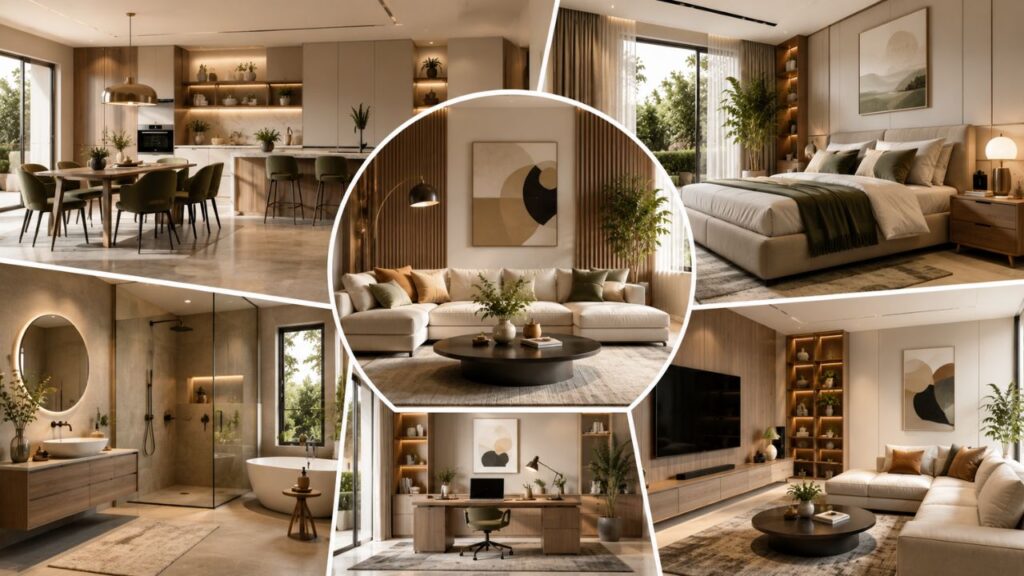
A grounded, earthy color palette is one of the defining threads running through 2026 interiors.
The Foundations Every Good Room Is Built On
Before choosing paint colors or scrolling through furniture catalogs, it helps to understand the handful of principles that quietly hold a well-designed room together. Skip these, and even expensive furniture ends up looking like it was placed at random.
Start With How You Actually Live
Ask yourself what actually happens in the room day to day. Do you eat dinner on the couch? Does the dining table double as a homework desk on weeknights? Furniture layouts should follow real habits, not showroom staging. Measure your space, mark out walking paths, and only then start thinking about specific pieces.
Color Sets the Emotional Tone
Color affects mood more than most people give it credit for. Warm tones like terracotta, rust, and ochre tend to energize a room and make it feel cozy, while cooler greens and blues slow things down and read as calming. A useful rule of thumb is the 60-30-10 ratio: sixty percent of a room in a dominant color, thirty percent in a secondary tone, and ten percent in an accent that adds contrast and personality.
Lighting Layers, Not Just One Overhead Fixture
A single ceiling light rarely does a room justice. Designers typically build a space with three layers: ambient lighting for overall illumination, task lighting for reading or cooking, and accent lighting to highlight art, texture, or architectural detail. Dimmers on at least the ambient layer make a bigger difference to how “finished” a room feels than almost any other single upgrade.
Bulb temperature matters just as much as fixture choice. Warm white bulbs, generally in the 2700K to 3000K range, tend to flatter skin tones and make living spaces feel relaxed, while cooler, brighter bulbs suit task-heavy areas like a home office or laundry room. Mixing warm and cool bulbs in the same room is one of the more common reasons a space feels subtly “off” without anyone being able to say exactly why.
Interior Design Trends Shaping Homes Right Now
Trends come and go, but a few themes have real staying power heading into 2026 — and they line up closely with how interior designmode24 approaches most projects: warmth, texture, and rooms that feel personal rather than showroom-perfect.
Modern Heritage
This look blends classic architectural details — moldings, traditional millwork, older furniture silhouettes — with updated finishes and contemporary comfort. Instead of a home that feels stuck in one era, it layers old and new so a space feels collected over time rather than purchased all at once.
Mixed Wood Tones
The old rule that every wood finish in a room had to match is fading fast. Homeowners are now pairing light oak floors with a walnut dining table and a mahogany-toned console, letting the variation add depth instead of worrying about perfect uniformity.
Earthy, Grounded Palettes
Stark white walls and cool gray everything are giving way to warmer, richer colors: olive green, espresso brown, terracotta, and soft ochre. These tones photograph beautifully, but more importantly, they tend to feel more livable day to day than a stark, sterile palette.
Softer Silhouettes
Curved sofas, rounded coffee tables, and arched doorways are replacing sharp angles in a lot of new builds and renovations. Soft shapes read as more inviting and make smaller rooms feel less boxy.
Layered Pattern
After years of minimalism, pattern is having a real moment — florals paired with stripes, an antique rug under patterned upholstery, textiles that complement rather than match exactly. Done well, it adds personality without tipping into visual clutter.
Room-by-Room Interior Design Tips
General principles are useful, but every room has its own quirks. Here’s how the interior designmode24 way of thinking plays out space by space.
Living Rooms
- Anchor the seating around a clear focal point — a fireplace, a window view, or a media wall — rather than pushing every piece against the walls.
- Leave at least 30 inches of walking space between major furniture pieces so the room doesn’t feel like an obstacle course.
- Layer a large area rug under the front legs of your seating to visually tie the grouping together.
Kitchens
- Keep the classic “work triangle” between the sink, stove, and fridge as unobstructed as possible.
- Mix matte and glossy finishes on cabinetry and hardware to avoid a flat, one-note look.
- Under-cabinet lighting solves both a practical problem and a styling one — it’s functional and instantly makes the space feel more considered.
Bedrooms
- Treat the bed as the room’s anchor and build the layout outward from it, not from the door.
- Invest in blackout or layered window treatments; sleep quality is arguably the highest-impact design decision in the entire house.
- Keep nightstands proportionate to the bed height so lamps sit at a comfortable reading level.
Bathrooms
- Warm metal finishes such as unlacquered brass or bronze are replacing cold chrome in a lot of 2026 renovations.
- Curbless showers and grab bars are increasingly built in from the start, not added later, to support aging in place.
- A single striking element — patterned tile, a statement mirror, an unusual vanity — goes further than trying to upgrade everything at once.
Home Offices
- Position the desk to face into the room rather than a blank wall, if space allows, to avoid feeling boxed in on video calls.
- A door that actually closes has become a priority again, as more people split work and family life inside the same home.
- Good task lighting near the desk reduces eye strain far more than a stylish desk lamp with the wrong bulb temperature.
Mapping traffic flow and functional zones before choosing furniture prevents a lot of costly redos.
Designing Small Spaces and Rentals
Not every project starts with a blank canvas. A lot of the interior designmode24 approach was actually developed for the opposite scenario — small apartments, shared rentals, and rooms with awkward angles or fixed layouts that can’t be changed. The good news is that scale and permanence aren’t the things that make a room feel designed; intention is.
Working With, Not Against, a Small Footprint
Multi-purpose furniture — a storage ottoman that doubles as extra seating, a console table that folds out for dinner guests — earns its keep in tighter spaces far more than a single-use piece ever will. Mirrors placed opposite a window can noticeably brighten a room and create the illusion of extra depth, which matters more in a studio apartment than almost anywhere else.
Renter-Friendly Upgrades
- Removable wallpaper and peel-and-stick tile can transform a rental kitchen or bathroom without violating a lease.
- Tension curtain rods and clip-on shades avoid drilling while still allowing for proper window treatments.
- Plug-in sconces solve the lighting-layer problem in rooms with no overhead fixture and no budget for an electrician.
None of these require a renovation budget, yet the cumulative effect can be dramatic. A rental that leans into these small, reversible changes often ends up feeling more considered than an owned home where every decision was made in a rush.
How an Interior DesignMode24 Project Typically Unfolds
Whether you’re working with a professional or simply borrowing the framework for a DIY refresh, most successful interior designmode24 projects move through the same broad stages.
Discovery and Consultation
This is where the real work happens, even though it doesn’t look like much yet. A good discovery conversation covers how the household actually uses each room, what’s not working currently, and what the budget realistically allows — before a single fabric swatch is pulled.
Concept Development
Next comes the moodboard: color story, furniture layout options, and material palette. This stage is where big decisions get made cheaply, on paper, instead of expensively, after delivery trucks arrive.
Sourcing, Execution, and Styling
Once the concept is approved, it’s time to source furniture and finishes, coordinate any contractors, and manage delivery timelines. The final styling pass — art, textiles, plants, accessories — is what actually makes a finished room feel lived-in rather than staged.
A repeatable five-step framework keeps design decisions organized from concept to reveal.
DIY or Hire a Professional? How to Decide
Not every project needs a professional, and not every project should be tackled alone. A simple refresh — new paint, updated textiles, rearranged furniture — is well within reach for most homeowners with a bit of research. Structural changes, full-home renovations, or projects involving multiple contractors are where a professional earns their fee many times over, mostly by preventing expensive mistakes and keeping timelines realistic.
A useful middle ground is a single consultation: paying for a few hours of professional guidance on layout and color, then executing the sourcing and styling yourself. It’s a way to borrow expertise without handing over the entire budget.
It’s also worth being honest about time, not just money. A DIY project that saves a designer’s fee but drags on for eight months of half-finished rooms carries its own cost — in stress, in wasted purchases made in frustration, and in simply not enjoying the home while it’s mid-transformation. If your schedule genuinely doesn’t allow for the research, sourcing, and coordination a project needs, that’s a legitimate reason to bring in help, independent of how confident you feel about your own taste.
Budgeting for a Design Project Without Losing Your Mind
Budgets fall apart most often not because people overspend on big items, but because dozens of small purchases add up unnoticed. A workable approach is to set a total number first, then allocate roughly by category: furniture typically takes the largest share, followed by lighting, textiles, and finally decor and accessories.
- Set aside 10–15% of the total budget as a contingency for the unexpected — it’s rarely wasted.
- Buy investment pieces (sofas, beds, dining tables) in timeless shapes, and save trend experiments for cheaper, swappable items like cushions and art.
- Vintage and secondhand pieces can dramatically stretch a budget while adding character that new furniture often lacks.
It also helps to separate “needs now” from “wants eventually” on paper before shopping starts. A dining table you eat on every night is a need; a matching bar cart is almost always a want that can wait. Ranking purchases this way keeps a limited budget pointed at the items with the biggest daily impact first, and leaves the more decorative layer for later, once the essentials are settled and there’s room to breathe financially.
Sustainable Materials Worth Considering
Sustainability has moved from a niche preference to a mainstream expectation in a lot of 2026 projects. Natural wood, wool, linen, and reclaimed materials tend to age better than synthetic alternatives, both in durability and in how they look over time. Choosing furniture built to be repaired rather than replaced — and finishes like unlacquered brass that develop a patina instead of scratching visibly — reduces both environmental impact and long-term cost.
Mistakes That Quietly Ruin a Room
- Buying a rug too small for the seating area, which makes the whole layout look disconnected.
- Hanging art too high — the center of a piece should generally sit at eye level, not ceiling height.
- Matching everything too perfectly, which can leave a room feeling flat and showroom-like instead of personal.
- Ignoring scale, such as placing an oversized sofa in a small room or tiny accessories on a large console.
- Skipping the walkthrough at different times of day — a paint color that looks perfect at noon can shift dramatically under evening lamp light.
Frequently Asked Questions
What does interior designmode24 actually mean in practice?
It refers to a modern, livability-first approach to interior design that blends current trends with timeless layout and color principles, always filtered through how a household actually uses a space.
How much should I budget for a single room refresh?
It varies widely by room and city, but a modest living room refresh (paint, textiles, a couple of new pieces) often falls in the low thousands, while a full furniture replacement and layout change can run considerably higher. Setting a firm number before shopping keeps decisions grounded, and pricing out a few key items early on gives a realistic sense of whether the plan needs to be scaled up or trimmed down before purchases begin.
Do I need to hire a designer for a small apartment?
Not necessarily. Small spaces benefit enormously from smart layout and proportion, which you can often manage yourself with careful measuring and a bit of research. A single paid consultation can still be worthwhile if you’re unsure where to start.
What’s the fastest way to make a room feel more expensive?
Layered lighting and well-placed art tend to have an outsized impact for the money spent, along with swapping out obviously cheap hardware — cabinet pulls, light switch covers, curtain rods — for slightly heavier, better-finished versions.
Are mixed wood tones actually going to look messy?
Not if there’s a common undertone linking them. Choosing woods that share either a warm or cool base tone, even if the shades differ, keeps the mix looking intentional rather than accidental.
How do I choose a color palette I won’t get tired of?
Lean on the 60-30-10 rule and keep your dominant color relatively neutral and warm, then experiment with trend colors in the smaller, easier-to-change accent layer — cushions, art, a single accent chair.
Is it better to buy furniture all at once or gradually?
Gradually, in most cases. Living in a space for a few weeks before finishing it often reveals what’s actually missing, rather than guessing everything upfront and ending up with pieces that don’t quite fit the way you live.
How often should a home’s design actually be updated?
There’s no fixed timeline. A better signal than years passed is whether the space still supports how you’re currently living — a home office added after a job change, or a nursery converted once kids grow older, matters more than chasing an annual refresh.
Final Thoughts
Good interior design was never really about keeping up with every trend cycle. It’s about paying attention — to how light moves through a room over the course of a day, to how a family actually gathers in a space, to the small details that make a house feel considered rather than assembled. That’s the thread running through interior designmode24 from start to finish: practical decisions, made in the right order, that add up to a home that feels unmistakably yours.
Whether you tackle one room or an entire house, the same approach holds up — start with how you live, build the foundations of layout, light, and color first, and let the trends fill in the details rather than dictate the whole plan.
Give yourself permission to move slowly, too. Some of the best rooms come together over months, not weekends, as pieces are chosen carefully instead of grabbed under pressure to finish. There’s no prize for speed here — only for a home that still feels right a year from now, long after the trend that inspired it has moved on to something else.